Monday, 14 June 2021

The Tomb of Sen- nejem in the workers Village of Dier El Medina


Leaving the ferry point you follow the main road  and pass the the Colossi of Memnon, you can collect your ticket to visit the tombs from the office at the side of the roundabout. Heading towards the Valley of the Queens you arrive in a  narrow valley on the right hand side, and here tucked into the hills opposite to the worker’s village of Deir el-Medina on the West Bank of Luxor, you can find the delightful tomb of Sen-nejem, the village foreman, this tomb is stunning, and in vibrant colour.

Sen-nejem was an architect whose tomb was discovered discovered by a Egyptian workers from Quorna, After three thousand years of peaceful rest, on the 2nd of February, 1886 the French Egyptologist Gaston Maspero opened the tomb, Sen-nejem and his sons were fortunate to live during a period of great prosperity for the Village they created two tombs in the valley of the Kings. Thankfully Sen-nejems own tomb had not been found by tomb robbers and so It contained grave household goods, along with shabti's, which  are small figurines with a spell on them so that if the deceased needs help in the afterlife they wake from their slumbers and do all that the deceased requires them to do for him. There was  nine sarcophagi and eleven mummies, they were very beautiful anthropoid, simple or double coffins, finely painted and varnished, and all belonged to members of Sen-nejems family.


Sen-nejem held the title, 'Servant in the Place of Truth,' a  Servant  was ’One who hears the call in the Place of Truth,' Sen-nejem lived during the reigns of Seti I and his son, Ramesses the Great of Egypt's 19th Dynasty, his tomb lies in the workers village, this was a secret village hidden away on the west bank and was created entirely for artisans who were responsible for  creating the tombs of the Kings and Nobles, the artisans worked on their own tombs when they had free time from working in the Valley of the Kings ( the Great Place) and the Valley of the Queens, (the Place of Beauty),  the artisans were cut off and not allowed to leave the village, supplies of food were delivered to them so that the secret of tombs of the Kings or Nobles tombs could not be discovered


The Artisans decorated their tomb walls with scenes of daily life, unlike the tombs of the nobles, who were prominent government officials and their walls showed their work of a vizier or a Judge, or in the tombs of the Kings, which showed the Kings being welcomed and helped through the underworld by the Gods.  A very steep staircase leads to a small entrance chamber which originally had a decorated wooden door, On the walls of Sen-nejems tomb you can see Sen-nejem and his wife Iyneferty working together happily in the blessed afterworld where they sow, plough and reap flax or wheat in the mythical fields of Laru


Above ground Sen-nejems tomb has a courtyard inside which sits a small pyramidion, pyramids were considered to be a ladder to the heavens, the underground section of Sen-nejems tomb had a room with a vault ceiling Sen-nejem, shared this “house of eternity” with his wife Iyinofreti, their son Khonsu, daughter in-law Tamakhet, the lady Isis, who was the wife of their second son Khabekhnet (who had his own tomb built next to Sen-nejem’s), together with their grandchildren. Both Sen-nejem and his wife lived into old age. Sen-nejem and Iyneferty had thirteen sons, two foetuses contained in uninscribed yellow wooden boxes were also found in the tomb 


Sen-nejem was highly skilled in tomb building, and together with the help of members of his own family and of other workers from the village, he was able to build and decorate his own house of eternity.  The tomb is very simple, and very colourful with a narrow stairway leading into a small room followed by the burial chamber and a highly curved ceiling, on the left front wall the scene is of the mummy of sen-nejem in his sarcophagus lying on a funeral bed and protected on the left by Isis and on the right by Nephthys, both in the form of falcons. Under this in a lower register is a scene of the deceased sons bringing him offerings and purifying themselves before his parents while other relatives sit nearby. In the next scene on this wall, the deceased is shown with his wife and is holding a sekhem-scepter, a symbol of power.

The ancient Egyptians believed that the deceased would embark on a subterranean journey, tracing the route of Re, the sun god. After disappearing with the setting sun in the west, Re passed under the world in a boat to return to his starting point in the east. During this journey, the deceased, aboard Re’s boat, would have to confront ferocious creatures barring the way to their new life. The most formidable of these was Apep, a serpent intent on stopping Re’s boat and bringing chaos to the world.


 The majority of the scenes in Sen-nejems tomb represent vignettes, which is a brief evocative description, of an episode from the Book of the Dead, the Book of the Dead is not an actual book in the manner that we would understand, its texts were spells—magic 'road maps' provided to the dead to navigate their way safely through the afterlife,  to help ease the passage of the deceased through the underworld, offering them protection to face the ordeals and terrors lying in wait there, the spells were written on tomb walls, papyrus, and linen bandages, the spells convey the sequence of the journey that takes Sen-nejem through the Underworld until he reaches paradise. Osiris, the God of the underworld, gives life back to Sen-nejem mummy and makes his judgement in the hall of Justice, the scenes are painted on a yellow ochre background, which has the color of an aged papyrus. Sen-nerjem and his wife Iyneferty are shown in adoration of several gods, also shown are two jackals, these are the guardians of the gates to the West, the Kingdom of Osiris, and they are the openers of the road to eternity. There are three lines of inscription between the two rows of deities which appeals to several gods, Atum, Osiris, Khenty-Imentiu, and the Enead, to grant the deceased strength, greatness, power, and dignity. There is a banquet in honor of the deceased, and Sen-nejems  son Bunakhtef, wearing a leopard skin  performs the role of a Sem priest, and he is shown carrying out libation, pouring from a Qeb vessel for his father.  Anubis is shown attending to Sen-nejem’s mummy

It is sad to think that Sen-nejem and all his family lay together for thousands of years in this little tomb, and now they have all been separated and can be found in different museums, along with all their possessions

Friday, 4 June 2021

Saint Catherine & the Monastery Dedicated to her on Mount Sinai Egypt

Saint Catherine of Alexandria, is also known as Saint Catherine of the Wheel, and The Great Martyr Saint Catherine, she was born in 287 as the daughter of the Alexandrian governor, according to tradition, Catherine is considered to be a Christian saint and a virgin, who was martyred at the age of 18 under the instructions of Emperor Maxentius (Marcus Aurelius Valerius Maxentius) who was a Roman emperor from 306 to 312. Before Catherine died she had converted hundreds of people to Christianity. 


Catherine was a princess of noble birth and learned in the sciences, at the age of 14  she became a Christian. When she was only eighteen years old, she presented herself to the Emperor Maximinus who was violently persecuting the Christians and she scolded him for his cruelty,  and endeavoured to prove it to him how sinful it was to worship false gods, the Emperor was astounded at this young girl's audacity, and he  had her  scourged and then imprisoned. Catherine was scourged so cruelly and for so long, that her whole body was covered with wounds, from which the blood flowed in streams. The spectators wept with pity, but Catherine stood with her eyes raised to heaven, without giving any  signs of suffering or fear. Maxentius then ordered her to be imprisoned without food, so she would starve to death. It is said that during the confinement, angels tended her wounds with salve, and that Catherine was fed daily by a dove from Heaven and that Christ also visited her, encouraging her to fight bravely, and promised her the crown of everlasting glory.

The Empress Valeria Maximilla was so eager to meet such an extraordinary a young woman, that she asked the head of the troops to escort her to visit Catherine in her dungeon, on leaving the dungeon both the Empress and the head of the troops had converted to Christianity, then twelve days later, when the dungeon was opened, a bright light and fragrant perfume filled it and Catherine came forth even more radiant and beautiful.

Soon afterwards Catherine, whose faith had increased with all the cruelty, converted many people. The Emperor was furious and condemned Catherine to death on a spiked breaking wheel, but, at her touch the cruel instrument of torture miraculously  shattered. The emperor, was enraged beyond control, and had Catherine  beheaded, Christians believe that the angels carried her body to Mount Sinai and it is here that the fortress style monastery was built in her honour.

St. Catherine’s Monastery is a Greek Orthodox Church dating to the 6th century and located in one of Earth’s holiest places: the valley below Mount Sinai, where the Prophet Moses is believed to have spoken with God and where he received the Ten Commandments. St. Catherine's Monastery was built between 548 and 565 it was constructed by the Byzantine Emperor, Justinian I, and was built to protect the monks who were living in caves and simple huts in the wilds of this sacred area, the monks regularly faced attacks from marauding Bedouins. The monastery in the valley below Mt. Sinai became known as St. Catherine’s after the saint’s remains were found by resident monks, in or around the year 800.  The architect, Stephanos of Aila (Elath), constructed the monastery in the style of a fortress of such monumental design that its walls have stood for over fourteen centuries with little changes, it is located on the Sinai Peninsula, and it ministers to all who come to the site as pilgrims, seeking spiritual consolation and an increase of their faith, it is sacred to Christians, Jews and Muslims. The monastery sits on the mouth of a gorge at the foot of Mount Sinai, near to the town of Saint Catherine, Egypt. The monastery is named after Catherine of Alexandria and is now protected as a UNESCO World Heritage site, it is the place where God called to Moses and instructed him to take off his sandals as he was in a holy place


From early Christian times to the present day, prayer and spiritual dedication have existed at Sinai, it was this area of the desert where God manifested himself as a burning bush and where he gave instructions to Moses, this sacred area gives a special aura to the monastery, and is a destination for pilgrims. 

I dedicate this BLOG to my dear friend Deena Younis, an exceptional young woman and friend

Wednesday, 28 April 2021

Akhenaten & Nefertiti - The Great Royal Wife - the Beautiful One has Come


Nefertiti was the great royal wife of King Akhenaten (formerly Amenhotep IV) her name translates to 'A beautiful One has Come, and indeed she was stunningly beautiful as a portrait bust of her was found on the 6th December 1912 by  a German archaeological mission led by Ludwig Borchardt during an excavation at Armarna, when the bust of Nefertiti was found lying in the ruins of the Amarna workshop of the sculptor Thutmose. despite a missing left eye on the bust, Nefertiti is still the  most beautiful female figure from Ancient Egypt. Nefertiti had many titles including:

Hereditary Princess 

Great of Praises 

Lady of Grace 

Sweet of Love 

Lady of The Two Lands 

Great King's Wife, his beloved 

Lady of all women

Mistress of Upper & Lower Egypt


It is believed that Nefertiti was daughter of the courtier Ay, who became pharoah after Tutenkhamun, Ay was the brother of Akhenaton’s mother, Tiy. 

Nefertiti bore six daughters within the 10 years of her marriage, to Akhenaten


Meritaten

Their eldest child Meritaten was born at Malkata towards the beginning of his reign, her name means, ‘She who is beloved of Aten'

Her name appears on an ivory writing palette – which probably belonged to her, in the tomb of Tutankhamun – her younger half-brother. Also a sarcophagus belonging to her was found within KV55 – which has recently been proven to house the mummy of Akhenaten.

Meketaten

Their second daughter Meketaten's  name means, ‘Behold the Aten’. Meketaten is frequently depicted in artworks from Amarna, and features with Meritaten and Nefertiti along boundary stelae of the new city of Akhetaten. She features with all of her sisters at the Parade of Foreign Tributes, and it has been said that she was married to her father – and died, presumably in childbirth 

Ankhesenpaaten (later Ankhesenamun)

The third royal daughter was born around Year 5  she later became the wife of her younger half-brother Pharaoh Tutankhamun, In Tutenkhamun's tomb two small foetus were found,  following his death she was married to his successor, Pharaoh Ay, who was also her maternal grandfather.

Neferneferuaten Tasherit

Was the first princess to be born at Amarna, Neferneferuaten was named after her mother, Nefertiti, whose name was changed to Neferneferuaten when the royals changed their names to embrace the Atenist religion. Her name means ‘Beauty of the Beauties of the Aten’, with the epithet ‘Tasherit’ meaning ‘Junior

Neferneferure

Princess Neferneferure's name means, ‘Beauty of the Beauties of Re’. who died  about the age of five, as she is not depicted at the mourning scene for Meketaten. Neferneferure is depicted on a crouching position upon a box-lid discovered in Tutankhamun’s tomb.

Setepenre

Princess Setepenre's name means ‘Chosen of Ra’, she was the youngest daughter and was about the same age as Tutankhamun. Akhenatens son by a minor wife. Setepenre is depicted with her sisters at the Parade of Foreign Tributes. It is likely that Akhenaten and Nefertiti’s youngest child died aged around three years of age, shortly before Meketaten, as she does not appear in the mourning scene.


Soon after Akhenaton’s 12th regnal year, one of the princesses died, three disappeared (and are also presumed to have died), and Nefertiti vanished. The simplest inference is that Nefertiti also died, but there is no record of her death and no evidence that she was ever buried in the Amarna royal tomb.

During his reign, Akhenaten enacted a series of shocking religious and societal changes, he instructed the Egyptians that they should only worship one God, The Aten, he closed all the temples of the Gods, and moved the capital to Akhetaten (Armarna, a completely deserted area with no influences of the previous religeon.) here  Nefertiti and Akhenaten are shown worshipping the Aten, or bathing in its radience with their children, Akhetaten grew quickly into a large, sprawling city on the east bank of the Nile River. Vast temples were dedicated to the Aten, left unroofed to be filled with light - thus eliminating the need for cult statues of the god. Offerings of bread, beer, cattle, fowl, wine, fruit and incense were given to the sun god on open-air altars. As the sun moved east-west over the temples, Akhenaten traveled north-south through the city in a golden chariot as the Aten’s representative on earth. Many layers of history have tried to destroy and eradicate this most unusual pharaoh, a man of peace, a man who made his own rules and defied the priests of Amun, a king not interested in following the traditions of dominance,  a man  that was eventually  broken by the overwhelming forces against him, enemies on his frontiers and a plague within his Capital that took the life of two of his beloved young daughters, his hopes were diminished and after his death his religion and the sanctuary he had created at Akhetaten was abandoned by his people,  the lonely life he had lead as a child, and his vision of one god, the Aten was rejected, he had brought Egypt to the brink of economic disaster with his non violent policy and his life of seclusion, his only interests in life had been the love of his wife Nefertiti his children and the worship of the Aten

The thing that is most unusual about Akhenaten and Nefertiti's relationship is that Akhenaten are shown in reliefs together and seem to appear as inseperable, Akhenaten and Nefertiti are often shown riding in chariots together and even kissing in public, they are shown as a happy couple enjoying the love a a family with their daughters, no other pharaoh has ever portrayed himself in this manner, occasionally queens were shown with their husbands, but in much smaller scale, and never with their children. I feel that Akhenaten and Nefertiti must have had a genuine romantic connection, a dynamic not generally seen in depictions of ancient pharaohs. In this image both Akhenaten and Nefertiti are bathed in the rays of life from the Aten


On arrival at Akhetaten Nefertiti changed her name to Neferneferuaten-Nefertiti, meaning "beautiful are the beauties of Aten, a beautiful woman has come," as a show of her absolutism for the new religion. 

Akhenaten went to great lengths to display Nefertiti as his  equal. In several reliefs, she is shown wearing the crown of a pharaoh or smiting her enemies in battle, no other pharaoh has ever portrayed his wife as an equal, their marriage and portrayal of their relationship is unique in ancient Egyptian culture.


If you would like to see an image of Nefertiti and Akhenaten when in Luxor, you must I would definitely recommend you to visit the Tomb of Ramose (TT55).  Ramose was the Vizier of both Amenophis 111, and Amenhotep1V (Akhenaten) the tomb is  situated on the hillside of Gurna based in an area known as the tombs of the nobles, in this tomb you can see the traditional tomb art and the amazing transformation that Armarna art brought to Egypt,  


The banquet scene for the funeral of Ramose is outstanding and stretches across the whole inner wall, this is so beautiful, there is no colour, just the eyes have kohline, the carvings and wigs are stunning. Akhenaten and Nefetiti are shown on the opposite wall beneath the Aten greeting envoys from other countries, the above image shows work in progress inside the tomb, it is dignitaries from other countries before Akhenaten and Nefertiti, the image of Nefertiti and Akhenaten has been vandalized as Akhenaten was known as a heretic king who had suppressed the worship of the God Amun, and by vandalizing their images it would symbolically deny them an afterlife, it is a mystery as to  what happened to this couple who defied thousands of years of the worship of Amun, and openly expressed their love and family.


Thursday, 8 April 2021

Howard Carter & the Discovery of Tutankhamun's Tomb KV62

Across the river Nile on the western shore of Thebes, there lays a desolate winding valley that hibernates within a barren and silent city for the dead, where no life can sustain on its parched desert rocks. In ancient days this was a secret place with only one way into the valley, its dusty road was only followed by the ritual funeral entourage of ancient times, and It encloses the subterranean tombs and final resting places of the once living Gods of Ancient Weset, the pharaohs of The New Kingdom. 

‘I am yesterday today and tomorrow, and I have the power to be born a second time' - The Book of the Dead

Taking the road that leads to the valley of the kings and passing a long sweeping bend you can see three unusual houses neatly spaced with domed roofs , passing beneath them as the moonlight glowed on the white walls of the house Howard Carter had used when working in The Valley of the Kings, I felt that it held ghosts from the past and memories of the presence of a determined yet stubborn man who had made a fantastic discovery. Entering Bilban el Muluk, the gateway of the Kings and passing through the winding avenue between its mountain walls, echoes reverberated round the bends and bounced off the high ridges and the ancient Madjay the bodyguards of the Kings of Egypt awoke from their slumber their ghostly army surrounded the edges of the Quorn


                                       Lord Carnarvon                   Howard Carter

Howard Carter (1874 –  1939) was the English archaeologist and Egyptologist who achieved fame in November 1922 on his discovery of  the most amazing  intact tomb in the Valley of the Kings, KV62 belonging to the young king  Tutankhamun, who had ruled during the 18th Dynasty. Despite the significance of his archaeological find, Carter received no honours from the British government. However, in 1926, he received the Order of the Nile, third class, from King Fuad I of Egypt.


Carter was trained as an artist by his father, and having English friends that encouraged his interest he started work in Egypt at the age of 17 as an artist of tomb  decoration, Carter’s first job was at the beautiful tombs of Bani Hassan in middle Egypt with their magnificent wall drawings and inscriptions, In 1892 he spent a season at Armarna working for Flinders Petrie who was considered as one of the best field archaeologists of this time, Petrie really did not believe that Carter would ever become a good excavator, but Carter proved Petrie wrong by unearthing several important finds. leaving Armarna he worked with Édouard Naville at Deir el-Bahari, where he recorded the wall reliefs in the temple of Hatshepsut. 


Hoopoe bird in an acacia tree painting by carter from the tomb of Khnumhotep 111, Beni Hassan

When the fifth Earl of Carnarvon, an Englishman who was in Egypt for his poor state of health, wanted to dig at Thebes, Maspero recommended Carter to him,  and so In 1907, Carter began work for Lord Carnarvon, who employed him to supervise the excavation of nobles' tombs in Deir el-Bahri, near Thebes. Gaston Maspero, head of the Egyptian Antiquities Service, had recommended Carter to Carnarvon as he knew he would apply modern archaeological methods and systems of recording. Carter soon developed a good working relationship with his patron who had received the concession to dig in the Valley of the Kings. Carter made a systematic search for any tombs missed by previous expeditions, in particular that of the Pharaoh Tutankhamun who was originally named Tutankhaten, whose father was known as the heretic pharaoh Akhenaten, who insisted that Egyptians must worship only one God, the Aten. When Akhenaten died Tutenkhamun became King, he was only nine years old,  together with his child bride Ankhesenpaaten  they arrived back in Weset, (Luxor)  and under the firm grip of Ay his chief advisor and General Horemheb they began to repair the damage that had been done to Ancient Egypt’s religion, it’s people and The City of Amun. Tutankhaten changed his name to Tutankhamun and ruled Egypt for a decade, his wife Ankhesenpaaten became known as Anaksenamun. Tutankhamun was the 12th king of the 18th Dynasty, until the age of 19 when he died suddenly. Anaksenamun had lost her childhood friend, her husband and two small children whose fetuses' were also found in the tomb in tiny coffins. She was alone and just turned twenty one years old.

In 1914, Lord Carnarvon received the concession to dig in the Valley of the Kings. Carter led the work, undertaking a systematic search for any tombs missed by previous expeditions,

Unfortunately the first world war interfered with their search for Tutankhamun, during the war years Carter worked for the British Government as a diplomatic courier and translator  He enthusiastically resumed his excavation work to find the tomb of Tutankhamun towards the end of 1917.

By 1922, Lord Carnarvon had become dissatisfied with the lack of results after several years of finding little. After considering withdrawing his funding, Carter was so convinced that he would find the tomb that he suggested to Lord Carnarvon that he personally would pay for another seasons dig, so consequently Lord Carnavon agreed to fund one more season. Carter never gave up on his ambition to discover the tomb of Tutankhamun, he searched methodically with a blind determination to find the young Kings tomb. On 4 November 1922, his young water boy Hussien abd el Rassoul accidentally stumbled on a stone, so Carter told his workers to dig in this area and they uncovered a flight of 12 steps that led to a tomb entrance.  


Carter had the steps partially dug out until the top of a mud-plastered doorway was found. The doorway was stamped with indistinct cartouches of Tutankhamun. On November 26,Carter reached the door to the tomb and wrote of his excitement,  ''the day of days, the most wonderful that I have ever lived through, and certainly one whose like I can never hope to see again.'  another note in his diary said ' it needed all my self-control to keep from breaking down the doorway and investigating then and there.' Instead, he refilled the stairway with rubble, he sailed across the  River Nile and sent an important telegraph to Lord Carnarvon asking him to come to Egypt swiftly as they had found the entrance to Tutankhamun's tomb Carter, waited an agonizing 20 days for Carnarvon and his daughter Evelyn to arrive from England Carter excavated the entire stairway of 16 steps, revealing the seal of Tutankhamun.

Carter wrote 'The decisive moment arrived. With trembling hands I made a tiny breach… . At first I could see nothing … but presently, as my eyes grew accustomed to the light, details of the room within emerged slowly from the mist, strange animals, statues, and gold—everywhere the glint of gold… . I was struck dumb with amazement, and when Lord Carnarvon, unable to stand the suspense any longer, inquired anxiously, 'Can you see anything?' it was all I could do to get out the words, 'Yes, wonderful things.'

 Tutankhamun’s mummy lay within a nest of three golden coffins, which fitted snugly one inside another like a set of Russian dolls.  Two of Tutankhamun’s three coffins were made of wood, covered with gold sheet. But, to Howard Carter’s great surprise, the innermost coffin was made from thick sheets of beaten gold. 


As Carter  looked through the hole, the flashlight revealed gold covered couches in the shape of monstrous animals, he saw statues of the king, caskets, vases, black shrines,  beds, chairs, a golden throne, boxes, chariots.  In spite of evidence of break-ins in ancient times, the tomb was virtually intact, and would ultimately be found to contain over 5,000 items.


5 months after  Howard Carter discovered the tomb of the pharaoh Tutankhamen, his benefactor,  Carnarvon, aged 57, died, he had a mosquito bite that had become infected  the Earl's death was reported as Pneumonia which was thought to be only one of various complications, arising from the progressively invasive infection, that eventually resulted in multi organ failure. His sudden death within weeks of the tomb's official opening inspired gossip that the tomb was cursed. Lord Carnarvon  died in a hotel in Cairo on 5 April 1923. Lady Carnarvon retained her late husband's concession in the Valley of the Kings, allowing Carter to continue his work.

Finally, on October 28, 1925, almost three years after the discovery of the stairway, Carter gazed with awe and pity upon the mummy of Tutankhamun. Carter's meticulous assessing and cataloguing of the thousands of objects in the tomb took nearly ten years. 


After his discovery and the tomb was closed, Howard Carter retired from active field work. He began collecting Egyptian antiquities himself, and became moderately successful. He lived between his home in Kensington Palace and winters in Luxor where he would often be found at the Old Winter Palace Hotel, mostly keeping to himself. 

In 1932, following the closure of the tomb, Carter returned to London. He was unwell and Hodgkin’s disease was diagnosed. Carter died in March 1939 at the age of 65. 

Carters funeral was held on 6 March, only nine people attended his funeral.

The epitaph on Carter's gravestone reads: 'May your spirit live, may you spend millions of years, you who love Thebes, sitting with your face to the north wind, your eyes beholding happiness', a quotation taken from the Wishing Cup of Tutankhamun, and 'O night, spread thy wings over me as the imperishable stars'


Monday, 5 April 2021

The Amazing Golden Mummies Parade - 140 years after their discovery by tomb robbers in DB320

140 years have passed since the discovery of the tomb known as DB320  this undecorated tomb contained the most amazing group of the greatest Kings Queens and royal family members from the New Kingdom Period  and was discovered by tomb robbers, the Rassoul brothers who kept the tomb secret for ten years, living off the goods from inside the tomb

Eventually after the imprisonment and beatings, and harassment of the village people at Gourna one of the Rassoul brothers confessed to knowing the whereabouts of  the tomb that had originally been the family vault of Pinedjem 1 a High Priest of Amun during the 21st dynasty who had declared himself a king. During his rule He had removed some of the kings from their own tombs, possibly to acquire some of their wealth. 

Once the mummies were investigated the authorities made arrangements to transfer them to Cairo, and so after 3,000 years of seclusion the Royal mummies left Dier El Bahari  and were carried by donkeys and mules to the banks of the River Nile where they were transported to Cairo. 

Women came to the riverbank and wailed in mourning for the deceased kings and their kin. Never in the history of any nation has there been such an awesome entourage of deceased royalty, the glory of Ancient Egypt rose again as their pharaohs travelled to safety in Cairo, their final resting place, where modern scientists now continue the work of some of the ancient priests to protect and preserve the mummies of their kings. They sailed for three days, all the way from Luxor to Cairo, but on their arrival in Cairo, the customs inspection did not want to let the mummies into the capitol as they needed to find a legal definition for the mummies. The customs authority eventually agreed to let them in, but only under a label that embarrassing notification that they were salted fish,

On 3rd April 2021, in a stunning celebration parade worthy of the Kings and Queens, some of the same mummies were taken in  vehicles to the amazing new museum in a spectacular parade they travelled in specially decorated vehicles representing festival barques to their new home, specially decorated vehicles, with vintage horse-drawn carriages and men in ancient costumes guiding them, and a drum-beating military band building up excitement.


The highly anticipated Pharaohs’ Golden Parade transporting the amazing royalty began their journey from Cairo’s Tahrir Square  at exactly 6:30 p.m. The vehicles were designed to appear like the ancient barques used to carry deceased pharaohs to their tombs they were transported from the 120-year-old Egyptian Museum in Cairo's central Tahrir Square to the newly inaugurated National Museum of Egyptian Civilization in the old Islamic city of Fustat. The mummies had their names inscribed on the sides and front of the vehicles in ancient Egyptian hieroglyphs and Arabic, signaling the start of the procession by moving in chronological order


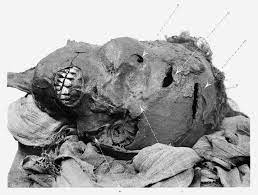
The first festival barque was dedicated to the mummy of King Seqenere Tao 11 who had lived 300 years before Ramses The Great and had ruled Egypt under the Hyksos period of invasion.  Seqenere Tao was also found in the cache at Dier El Bahari, his mummy shows that he had died of a violent death, where blows from a battle axe had left a gaping hole in his skull, His son Ahmose 1 was also found in the cache, and his mummy now lies in the Warrior Kings section of Luxor museum along with Ramses 1 who had been sold by the tomb robbers for 7 Egyptian pounds


Ahmose-Nefertari was the first Great Royal Wife of the 18th Dynasty of Ancient Egypt. She was a daughter of Seqenenre Tao and Ahhotep I, and royal sister and wife to Ahmose I. Her son Amenhotep I became pharaoh. Ahmose-Nefertari was deified after her death.


A 19-meter-high Ramses II obelisk surrounded by four sphinxes adorns historic Tahrir Square, the obelisk with it’s perfect sharp edged sides reach for the sun, paying homage to the god Ra, whose rays flash down it to highlight  bold vertical lines of deep inscriptions that inspire the traveler to utter the names of Ramses making him immortal once  more,   his authority of the land is invoked and assured again, The Horus, Mighty Bull, Exalter of Thebes, Favorite of the Two Goddess, establishing monuments for his father Amun who placed him on the Throne, Golden Horus seeking excellent things for him who fashioned him King of Upper and Lower Egypt, Usamatre, Chosen of Re.


As the vehicles moved, they encircled the obelisk and continued their 4.5-km journey to the National Museum of Egyptian Civilization, their final resting place. Roads were sealed off as the motorcade passed through empty streets before being greeted by a 21-gun salute upon arrival.

The number of mummies and coffins transported is 22 ,18 of the mummies are for kings, while 4 belong to queens. 

Among the mummies transferred those of  King Ramses II; King Seqenenre Tao; King Thutmose III; King Seti I; Queen Hatshepsut; and Queen Meritamen, the wife of King Amenhotep I; and Queen Ahmose Nefertari, the wife of King Ahmose I. 

Thutmose III  was the sixth pharaoh of the Eighteenth Dynasty, he was one of the strongest Pharaohs, a warrior king, who brought vast wealth to Egypt. When Napoleon Bonaparte invaded Egypt they gave him the Name of the Egyptian Napoleon as they were so impressed with his victories that were written on the walls of Karnack Temple. Tuthmosis ruled Egypt for almost 54 years and his reign from the age of two and until his death at age fifty-six; however, during the first 22 years of his reign, he was coregent with his stepmother and aunt, Hatshepsut, who was named the pharaoh. 


Becoming the sole ruling pharaoh of the kingdom after the deaths of Hatshepsut, he created the largest empire Egypt had ever seen;  he spent most of his reign in 17 campaigns  and he conquered lands from the New Kingdom in northern Syria to the Fourth Cataract of the Nile in Nubia bringing great wealth to Egypt, he tried to erase Hatshepsut to deny her an eternal life by erasing her name from the monuments that she had erected

One of the festival barques transported Queen Hatshepsut Maatkare ‘Foremost of Noble Ladies, Truth is the Soul of Re'  ruled as the fifth pharaoh of the 18th dynasty of Egypt, she was the favorite daughter of Tuthmosis 1, and was married to her half brother also known as Tuthmosis. Hatshepsut and Thutmose II (who was also in the parade) had a daughter named Neferure, who grew to become a Gods Wife of Amun. After having their daughter, Hatshepsut could not bear any more children. Hatshepsut ruled for 22 years, by the time of Hatshepsut’s death Tuthmosis 111 had risen up the ranks of the army to the Rank of Commander in Chief. 


When Tuthmosis 111 arrived back in Waset (Luxor) he had many of Hatshepsut's cartouches and images erased so that her name would be forgotten, and she would be denied an eternal life, he had a wall built around her obelisk in Karnack Temple to bind the energy of the obelisk.

The inscription written on the obelisk from Hatshepsut in Karnack Temple expresses her devotion to Amon Ra:

I have created this work with a heart full of love for Amon

Initiated into his secrets of origin

Instructed through his beneficial power

I have not forgotten what he has ordained

My Majesty recognizes his Divinity

I have acted on his orders

It is he who has guided me

I have never slept because I was pre-occupied with his temple

I have never turned away from what he has commanded,

My heart moved intuitively with The Father

I have entered intimately into the plans of his heart

I have never turned my back on the Master of totality

But rather I have turned my face towards him. 


Hatshepsut ruled for 22 years, by the time of Hatshepsut’s death Tuthmosis had risen up the ranks of the army to the Rank of Commander in Chief. 

When Tutankhamen’s tomb was cleared of all its wealth and finery, they came across a small box that held a lock of his grandmother’s hair. Tests were concluded in the 1970's on a piece of the hair and it confirmed that the 'Elder Lady' was the grandmother of Tutankhamun, the mother of Akhenaton, and the Great Wife of Amenophis 111- Queen Tiye, was the daughter of a chariot officer and therefore a commoner so it was unusual that she was the Great Wife of a King. Amenophis 111 obviously loved and respected his wife because he also had her depicted on statues with him, she embraces his leg on the colossi of Memnon


The music for the parade of the Golden Pharaohs'  is composed of the Isis hymn at Deir el-Shelwit at western Luxor, one of the most beautiful and powerful Hymn for Isis, and from the pyramid text, 


The Hymn to Isis during the Pharaohs’ Parade in Hieroglyphics 

“Oh, Humans and Gods who are in the mountains

She’s the great Lady 

Praise to you isis who gives birth to the Light

Praise to Isis mistress of the west and all Lands 

Praise to Isis the eye and Will of Ra 

Praise to Isis that Gives all that is good and blessed to Egypt”


Sunday, 4 April 2021

The Holy Barques of the Gods and Kings in Ancient Egypt

 The holy Barque of Ra began its journey  across the sky each day at sunrise and was known as Mandjet As the Barque of Ra descended into the west in the evening, it entered the underworld where the Apophis snake waited to attack it. Try and imagine the tombs with an invisible passage of water that flows within a dark tunnel of fear and chaos that could ultimately lead you to the light and eternity. A golden solar barque that has soaked in the rays of the sun during the hours of the day will now be empowered to travel through the caverns and darkness of the night on this eternal carrier of light, and it waits for you, your perilous journey through the underworld has begun. 

The Nile River was the source of life for the ancient Egyptians and it played a huge part in their religious beliefs. At night, the Milky Way was considered to represent the heavenly River Nile, and the solar barques of the deceased kings sailed the milky way with their companions to help them travel through the perilous hours of the night, to hopefully reach eternity at sunrise. Other gods, as well as the souls of the justified dead, would travel on the barque with Ra to protect him and his barque from Apophis during its journey through the underworld. Every night the gods, souls, and humanity joined together to battle chaos and darkness and preserve life and light, and each time they won, the sun rose in the morning, and the dawn light was an assurance that all was well with Ra and life on earth would continue. As the barque sailed across the sky, however, Apophis returned to life in the underworld and would be waiting again once night fell; and so the battle would have to be fought again.

All the pharaohs and the Gods had their own holy Barques, The barques could be actual sailing vessels or ceremonial barques carried on poles in festivals. Amenhotep 111 (also known as Amenophis) had his palace at Malkata on the West Bank on the edge of the desert, the palace had its own harbour and a canal that lead to the River Nile, so that he could sail down the canal onto the river, Amenhoteph's barque was called 'Aten Sparkles'.  The Goddess Hathor whose earthly home is Dendera Temple had a barque that she would travel in once a year to visit her husband the God Horus,  in his earthly home of Edfu, her barque was called 'Great of Love'

On the ceiling in the court of Heaven at Dendera Temple there is a  procession of barques that carry all the gods of the sky, surrounding them and above their heads are golden stars which represent the homes of departed souls, and the silver and golden star gates to travel back and forth between heaven and earth.


The Pharaohs built beautiful barque chapels inside Karnack Temple that can be seen in the open air museum in the precincts of Karnack Temple. the materials used were various shades of alabaster, turin, limestone, and the most unusual barque chapel in the museum was created by Hatshepsut for the God Amun. Hatshepsut began the creation of the Red Chapel during the later years of her reign to replace the alabaster chapel of Amenophis 1 and as original as ever she chose to make it from Red Quartzite blocks, an unusual choice of material to use as it has a deep red ochre colour and not normally chosen for a barque shrine. The rectangular shape has three doorways, two rooms, and an open roof.  The first room is a small vestibule and the larger second room was the sanctuary to shelter the boat of Amon on a small altar of rest.  The floor is paved and has a gully that the waters of purification would flow through during the ritual ceremonies


In the tombs  pharaohs had miniature boats made of wood and clay that were buried next to the mummy, in this way these boats were of the utmost importance to ensure the deceased passage to another life.

The  ship of Khufu is an intact full-size vessel that was sealed into a pit at the foot of the Great Pyramid of Giza around 2500 BC. The ship was discovered in 1954 by an Egyptian archeologist and has been fully reassembled and is on display in the Giza Solar boat museum, Khufu would sail through the heavens in the afterlife in this amazing vessel.


Thursday, 25 March 2021

Horemheb - The Commoner and General who became a King - the Conflict of Akhenaten & Horemheb

Horemheb was the commander in chief of the army under the reigns of Tutankhamun and Ay, and  even though he was a commoner, he became the final pharaoh of the 18th Dynasty.

Horemheb had begun his military career during the chaotic reign of Akhenaten, when ascended to the throne his name was Amenhotep IV, In the fifth year of his reign Akhenaten abruptly changed his observance from the cult of Amun to that of Aten, he closed all the temples, the ancient Egyptian Gods 'earthly homes' and he insisted that there was only one God, the Aten.  Akhenaten ignored developments beyond Egypt’s borders and even most events outside of his palace at Akhetaten, he brought Egypt to the verge of chaos and used most of its wealth to fulfil his own dreams

After his death, it was declared that Akhenaten was a heretic pharoah, his son Tutenhaten changed his name to Tutenkhamun and became pharoah.  Because of Tutenkhamuns young age,  he was nine years old when he ascended to the throne, he was guided by both Ay and Horemheb. It is thought that Tutankhamun even intended for Horemheb to be the sovereign because he made him the 'Hereditary Crown Prince'  before his death.

Horemheb eventually took the throne after Ay’s death, he became the king after a military coup, his throne name, Djeserkheperure Setepenre, means "Holy are the Manifestations of Re, showing his support of the God Amun. Once Horemheb became king,  he recommenced rebuilding the earthly home of the major God, Amun Ra (at Karnack Temple) that had been desecrated during Akhenaton’s revolution. The image below is actually an image of Tutenkhamun, but Horemheb has erased Tutenkhamuns name and replaced it with his own, also it is interesting to notice that the image has the look of Armarna art, not traditional Ancient Egyptian art.


To strengthen his rise to pharaoh Horemheb married a songstress of Amun, the lady named Mutnodjmet, who was the sister of Akhenatens beautiful wife Nefertiti. Mutnodjmet was Horemhebs second wife, but  she sadly died in child birth. 

After his accession to the throne it was  considered that Horemheb was the  ruler who brought stability back to  Ancient Egypt after the turmoil of Akhenatens reign, who had abolished the worship of Amun Ra and all the major gods, closing the temples in favour of worshipping one God, the Aten, and creation of a new capitol by Akhenaten known at Akhetaten  during the Armarna Period, which saw many changes including the art work of the temples and tombs


During the Amenhoteps  reign he changed his name to Akhenaten, and to express his devotion to the Aten, and he created a temple outside the  boundaries of the Precinct of Amon-Re, Karnack Temple to its east. This temple in the complex was named Gempaaten, which means 'The Sun Disc is Found in the Estate of the God Aten'  Very little of Akhenatens buildings remain; they were built quickly, using Talatat blocks, and could therefore easily be demolished . There is a wall of Akhenatens Talatat on display in Luxor Museum. Once Horemheb became Pharaoh he demolished all the monuments created by Akhenaten, which would deny Akhenaten an eternal afterlife, and he used the rubble in his own building projects, and he also usurped monuments of Tutankhamun and Ay.  Horemheb  built two  pylons in the precincts of Karnack temple, the ninth and tenth pylon, and  a gateway for himself. Amenhotep III who was the father of Akhenaten, and grandfather of Tutankhamun originally began the construction on the tenth pylon, but only the lowest courses were completed before his death. Amenhotep 111 was considered to be a great King, unlike his son Akhenaten.  In an effort to erase the memory of Akhenaten’s heresy, Horemheb took down Akhenaten’s temple, and filled his ninth pylon with the blocks of Akhenaten's temple. The pylon towers depict Horemheb in the classic Egyptian style, with Horemheb symbolically much larger than the enemies that he is 'smiting' To express that the King is powerful and has cast down his enemies.  The walls of the court were inscribed with scenes showing Horemheb making the journey to the exotic foreign land called Punt and returning with fabulous treasures.

It was during the reign of Horemheb that the first attempts were made to eradicate Akhenaten out of Egyptian history, Horemheb began repairing the temples of Amun, as well as restoring its priesthood. however, realizing the problems that this powerful priesthood caused for previous kings, he chose military men who's loyalties he could trust to be appointed as priests. Horemheb also usurped all of Tutankhamen’s monuments. Every monument that Tutankhamen had been advised to erect, Horemheb erased the name of Tutankhamun and replaced with his own name. 

When Horemheb died without an heir, he choose his faithful comrade-in-arms, Pa-Ramessu to rule, Pa-Ramessu became known as Ramses 1, he was the father of Seti 1 and Grandfather of Ramses the Great. Rameses 1 mummy can be seen in the Military wing of Luxor Museum.

Horemheb had two tombs, the one he commissioned for himself when he was a General at Saqqara, and when he became king he had another tomb (KV 57)  created in the Valley of the Kings, which was unfinished by the time of his death. The entrance to the tomb was discovered by Davis and his co-worker Edward R. Ayrton on the 25th February 1908. 


The decoration of the tomb, which used  raised relief work on a base of blue paint, is of a high quality. On its discovery, by Davis, the tomb was found to still contain several items of interest. These included a red granite sarcophagus and a calcite canopic chest, the mummy of Horemheb has never been found