Tuesday, 11 June 2019

The Mortuary Temple of Hatshepsut at Dier El Bahari


The MORTUARY TEMPLE of HATSHEPSUT
       
Splendor of Splendors

 Riding my bike through a gorge of twisting pink rippled rock I noticed small caves occasionally where alabaster had been quarried from. It was not long before I saw facing me the stunning Temple of Hatshepsut. I stopped pedaling and slowly the bike cruised to a standstill, I wanted to let the experience of this really dramatic and impressive stage like temple with its gleaming white limestone colonnades seep into my bones. The Osiris statues of Hatshepsut smile down on the traveler in amused triumph holding the flail and whip, a symbol of power and fertility. It was incredible to stand and look at this hidden place of worship, admire it's breath taking simplicity of line and at the same time try and comprehend how such things could be accomplished thousands of years ago, a beautiful temple driven into and becoming part of the sheer pink and gold rock face that rises around it. This temple is the one thing above everything that testifies the strength and determination of a woman in a male dominated world.


Hatshepsut’s mortuary temple is dedicated to the Goddess Hathor (Het-Heru) 'Lady of Heaven' who was the daughter of Nut and Ra, the wife of Horus, and mother to Ihy, Hathor was also considered a mother Goddess and the Mother of the King. In her Human form Hathor unusually has the serene yet beautiful face of a woman yet her ears are those of a cow, one of the relief’s in the temple shows her in the form of a cow as the pharaoh suckles from her. Hathor was also honored as ' Lady of the Western mountain' this refers to the place of the setting sun and the realm of the dead, she was a Sky Goddess, a protector of cemeteries, a Goddess of the dead, a goddess of love, she presided over fate healing music and dance. Some of the columns on the highest level of the temple are made in the form of a sistrum; a musical instrument that is sacred to Hathor and was always used in temple rituals and celebrations. These columns are a representation of the sistrum handle and above this sits the head of Hathor which also has a representation of the metal loop of the sistrum.


Queen Hatshepsut Maatkare ‘Foremost of Noble Ladies, Truth is the soul of re' came to rule during the 18th dynasty, she was the favorite daughter of Tuthmosis 1, and was married to her half brother. When their father died her husband ascended the throne and became Tuthmosis 11 the 4th king of the 18th Dynasty. He married the courageous and energetic Hatshepsut to strengthen his right to the throne. Tuthmosis 11 only reigned for a year with Hatshepsut when he died, and so his son by a minor wife, Tuthmosis 111 was appointed heir.  Due to the young age of this boy king Hatshepsut became regent and reigned on behalf of the boy, who later grew up to become one of Egypt’s greatest military pharaohs, the French were so impressed by Tuthmosis 111 military skills that they gave him the name the 'Egyptian Napoleon' .

Hatshepsut was content  to reign as regent. In the early years.  During the reign of her father Tuthmosis 1 Hatshepsut had been allowed to be involved with the dealings of his government, which had obviously inspired her confidence and a strong will to get her own way in life, and so she initially used  the strength of her fathers favoritism to her benefit,  she  also held the strong position among the Theban priests as the mortal Gods wife of Amun,  this position alone offered her  a superior  power,  as to be the living wife of the God Amun Ra is higher than to be the wife of a king.,  with this power  and support of the priesthood of Amun, she was able to seize control, casting aside the young Tuthmosis whom she sent away to train as a priest and scribe and then later as a soldier. By the time of Hatshepsut’s death he had risen up the ranks of the army to the Rank of Commander in Chief. During his years away from Thebes Hatshepsut declared herself as Pharaoh and began to dress as a man, many statues represent her as a king with a false beard. On the mortuary temple walls her birth relief’s  portray that it was the divine intention of both her  earthly father Tuthmosis 1 and her heavenly father Amun that she would rule Egypt, In the birth Colonnade it declares: ‘Amen –Ra called for the god Khumn the creator and fashioner of the bodies of men.’ Fashion for me the body of my daughter and the body of her Ka, a great queen shall I make of her, and honor and power shall be worthy of her dignity and glory’  ‘Amun-Ra answered Khumn ‘It shall be done as you have said.  So Khumn fashioned the body of Amen-Ra’s daughter and the body of her Ka, the two forms exactly alike, and more beautiful than the daughters of men. He fashioned them with clay from the air of his potters wheel and Heqet goddess of birth with the frogs head, knelt by his side holding the sign of life towards the clay that the bodies of Hatshepsut and her Ka might be filled with life and breath, and so one of the greatest queens of Egypt was announced to the world.

Hatshepsut had a peaceful reign, she concentrated on trade rather than conquest, the walls of her temple shows her famous trading expedition to the Land of Punt, now known as Somalia. To indicate their willingness to submit to an Egyptian sovereign the people of Punt showered the Egyptians with gifts for Hatshepsut. Their gifts included gold and ivory, great heaps of precious balsams and incense for the temples, animals plants and trees for transplantation on the Egyptian soil,  this is recorded on the punt colonnade, where small African houses are shown standing on wooden stilts, beautiful tropical birds are carved flying across the sky and lots of varieties of fish are recorded

Hatshepsut’s name had reached as far as the circuit of heaven and encompassed the great circle (the sea) the best of myrrh was upon her limbs and her fragrance was of divine dew, whilst her odour was mingled with the land of Punt. Her skin was gilded with electrum that shone like the stars at night
Foreign lands were regarded as the personal property of The Goddess Hathor, and the goods that the Egyptians obtained from these countries were considered to be gifts from Hathor, so the return to Thebes with all the treasures from Punt would have been the cause for great celebrations. Now that her reign was strengthened and successful, Hatshepsut made plans with her architect Senemut to build herself a Mortuary Temple fit for a King, and so her unusual three storied columned temple rose up the side of the Theban Mountains of El Dier El Bahari. When looking at a map I realized that the temple with its entrance ramps is in direct line with Karnack Temple the House of Amun on the East Bank, Sheshat the goddess of the Cosmos guided the priests with her skills of the stars and heavens, to achieve such an accurate invisible line from Hatshepsut’s temple to Karnack temple. Originally Myrrh trees lined the entrance ramps and its lower terrace up into the temple; these were trees that had been sent from the expedition to punt and are shown being transported in large baskets on the reliefs in the temple. Polish Archaeologists have restored much of Hatshepsut’s Temple to its former glory.

Having brought prosperity and peace to Egypt Hatshepsut disappeared from all records as to her death or whereabouts leaving us with a mystery. Tuthmosis 111 was now a grown man and he claimed the supreme power that he had been denied for so many years, systematically he ordered Hatshepsut’s cartouches and monuments to be defaced or destroyed to curse her with permanent death, by doing this he was satisfying the ancient belief that whilst a person’s name existed or was still spoken, immortality would be gained so by defacing her cartouches he was denying her eternal life.  It was believed that Hatshepsut’s mummy had been buried with that of her father's Tuthmosis 1 in KV20, but when Howard Carter found their tomb on 1903 both their mummies were missing. Thirty years earlier  Ahmed Rassul was searching the hillside for a lost goat, he could hear it bleating and so he followed the sounds until he found himself stood at the edge of a shaft that the goat had obviously fallen into,  Ahmed climbed down a rope into the shaft, once inside the tomb he realized he had found a great collection of mummies, so he retrieved the goat and went in search of his brothers to tell them of his discovery, together the brothers decided that they needed a plan to  keep people away from the tomb and protect their discovery ensuring their wealth to come. They returned to the tomb and threw a dead donkey inside the shaft, the stench of the donkey as it decayed would erase any further curiosity from others, and possibly convincing any suspicious minds that a demon had woken in the tomb. Over the next ten years the tomb robbers prospered with their treasure trove that gradually made its way to the hands of collectors and auction houses. Eventually The Antiquities service realized that a tomb must have been found, and so Sir Gaston Maspero sent one of the museum staff Emil Brugsch to discover where the artifacts were coming from. Emile presented himself as a wealthy buyer which gained the trust of the traders, and finally led him to the Abd Rasul Brothers. The brothers were arrested and tortured and despite a severe beating on the soles of the feet they would not give their discovery away, eventually after a month they were released, but then the police harassed their family and the villagers at Quarna continuously until eventually one of the brothers confessed to the police where the tomb was to avoid any further harassment of themselves or the rest of the villagers.

Once the Rassul brothers confessed to knowing the whereabouts of the tomb they begrudgingly led Emile Brugsch to the cliffs at the side of Hatshepsut’s mortuary temple at Dier El Bahari and he was guided down a rope into a tomb where to his amazement he found not one mummy case but the remains of over forty mummies. The tomb is known as DB320 it had originally been the family vault of Pinedjem 1 a High Priest of Amun during the 21st dynasty who had declared himself a king. During his rule He had removed some of the kings from their own tombs, possibly to acquire some of their wealth,  after his death further kings moved them again and amidst all the confusion the kings all finally were found in this one vault, Some of the mummy cases held the bodies of the greatest pharaohs of all time, including Seti 1 whose empty sarcophagus had originally been found in his tomb by Giovanni Belzoni, Ramses 11 ‘The Great’, Tuthmosis 1, the father of Hatshepsut, who had also been the first King to be buried in The Valley of The Kings. His burial had been carried out in great secrecy and entrusted to a High Court Official named Ineni, Tuthmosis 11 and his son Tuthmosis 111 princes, princesses, court officials and royal grandchildren. Queen Nefatari’s mummy case was also found in the cache and took sixteen men to lift its weight and move it alone. The Coffin of Ramses 1 was found in this vault but his mummy was missing, it has since been discovered that the robbers had sold Ramses 1 to a Canadian man for seven pounds

After 3,000 years of seclusion the Royal mummies left Dier El Bahari  and were carried by donkeys and mules to the banks of the Nile where they were transported to Cairo. Women came to the riverbank and wailed in mourning for the deceased kings and their kin. Never in the history of any nation has there been such an awesome entourage of deceased royalty, the glory of Ancient Egypt rose again as their pharaohs traveled to safety in Cairo, their final resting place, where modern scientists now continue the work of some of the ancient priests to protect and preserve the mummies of their kings.

Eight anonymous mummies were also found in another cache in 1881.  I had wondered initially if one of the mummies from this cache was a tomb robber. He must have committed some form of sacrilege to the royal mummies to have been subjected to such  a heinous death, his coffin was  found abandoned in the  corridor alone, whilst the remainder of the  mummies were in the burial chamber, there were no  inscriptions on the coffin  to indicate the man's name and the coffin had also been sealed down to prevent escape, he was probably a noble as his ears had been pierced which is a sign of high birth or priesthood, yet his body was wrapped in a sheepskin, this is a ritually unclean burial, perhaps it was Pertwere, the son of Ramses 111  whose mother had instigated the harem plot,  his hands and feet were bound together,  his face was distorted showing him screaming in terror , and his genitals had been sliced off.  The High Priests would be satisfied  that this man would die in lingering torment   whilst his soul  would be cast into the chaos of eternal death instead of the eternal life that  Egyptians craved,  it would be considered a just punishment  for trying to usurp his fathers throne . 
The mummy of King Seqenere Tao 11 who had lived 300 years before Ramses The Great and had ruled Egypt under the Hyksos period of invasion was also found in the cache at Dier El Bahari, he had died of a violent death, blows from a battle axe had left a gaping hole in his skull, it has been suggested that he was betrayed by the un-named mummy whom the priests had condemned to the horrendous death in the un-named coffin. His son Ahmose 1 was also found in the cache, and his mummy now lies in the Warrior section of Luxor museum.

A second cache of mummies were discovered by Victor Loret in 1898, one of the mummies was given the title 'Elder Lady' as their were no means of identifying her, many years passed before her body was finally identified. When Tutankhamen’s tomb was cleared of all its wealth and finery, they came across a small box that held a lock of his grandmother’s hair. Tests were concluded in the 1970's on a piece of the hair and it confirmed that the 'Elder Lady' was the grandmother of Tutankhamun, the mother of Akhenaton, and the Great Wife of Amenophis 111- Queen Tiye, who was the daughter of a chariot officer and therefore a commoner so it was unusual that she was the Great Wife of a King. Amenophis obviously loved and respected his wife because he also had her depicted on statues with him, she embraces his leg on the colossi of Memnon
Once the excitement of finding the cache of the most famous of the New Kingdom Kings had dissipated, people then began to ask, ‘where is the mummy of Hatshepsut?’ In 1903 Howard Carter found an undecorated tomb that had been pillaged in antiquity, inside the tomb laid the mummies of two women, this tomb was not of much interest to Howard carter as it did not contain treasure that it was his ambition to find, so he resealed the tomb and wrote a few notes of its condition and whereabouts. Three years later Edward Ayrton entered the tomb that had been registered as KV60 to collect one of the women who was laid in a coffin so that she could be shipped to Cairo; the inscriptions identified her as Sitre, who was the nurse of Hatshepsut. The tomb was then sealed again leaving the remaining woman alone to the silence of more years in an empty tomb,  its whereabouts were then lost and the lady forgotten about until another eighty years had passed, and then in June 1989 an archaeologist named Donald P Ryan rediscovered the tomb again, rubble and sand were cleared away until he was able to climb down a staircase leading into the depths of the tomb where fragments of pottery wooden coffin pieces and mummy wrappings littered the floor. Arriving at the burial chamber he found the mummy of the abandoned lady lying in the middle of the room.  Although no inscriptions were found that could help identify the lady she was obviously of importance and high ranking as she had been buried in the Valley of the Kings, although the tomb she was found in was undecorated I began to wonder could Tuthmosis 111 have wished to deny Hatshepsut the pleasure and magical words with the prayers of a decorated tomb? That would assist her journey to an eternal life. In a niche Dr.Ryan also discovered a small piece of a face from a coffin, thieves had removed the gold foil covering, but this fragment had a notch at the chin which could have been used to hold a false beard,   Hatshepsut wore a false beard to represent herself as a pharaoh. The evidence found within this tomb suggests that one of these ladies could have been Queen Hatshepsut herself. I have always admired Hatshepsut, and I do believe that you can’t keep a good woman down, she deserves the best, and I wonder if that is also why her Osiris statues smile as they survey the land from the terrace of her mortuary temple, this queen has risen again and will take her rightful place.

In 2007 Dr. Hawas investigated four mummies that had been taken to the Cairo museum, two from KV60 and two from DB320, he also had a wooden box that bore the cartouches of Hatshepsut, which contained the liver of the queen, and also a tooth that had fallen from the mummy during preparations for burial, so the embalmers put the tooth into the box.  With modern technology cat scans and close dental inspection of the mummies, they found that the lady from KV60 was missing a tooth, but the hole left behind and the type of tooth that was missing was an exact match for the loose one in the box from DB320 Which therefore offers the proof that this is the mummy of Queen Hatshepsut. And so finally this Amazing Queen will take her place with other royalty in the Cairo Museum once more.

Finally I feel that I cannot ride away from this momentous cul-de-sac of strength without relating to you the story of loyalty and honor that I have been told of that once lay in the tombs  near to the ruins of Mentuhotep’s Mortuary temple at the side of Hatshepsut’s temple. In 2040 BC Mentuhotep fought and won a battle against the leaders of the North of Egypt. Many of his soldiers died on the battlefield for him, and so to honor them he had sixty of their bodies collected and buried in the tombs facing his mortuary temple. It was their courage and sacrifice that had elevated him to ruler of all Egypt, and united the Two Lands of Upper and Lower Egypt, he became the founder of the Middle Kingdom and his Mortuary Temple was the first to be built at Dier El Bahari until the architect Senemut raised the  larger Temple of Hatshepsut at it's side.


The Rammessium


The RAMMESIUM
The Mortuary Temple of Ramses 11
The Mansion of a Million years

My bike ride from the ticket office roundabout took me up a long winding hill; I glanced over as I passed the tombs of the Nobles, sweeping down the hillside on my bike I arrived at the Mortuary Temple of Ramses 11 known as The Rammessium. It was a 'Mansion of Eternity', dedicated to Osiris, Amun and Ramses 11.  Areas of the temple now lie in ruins due to the damage caused by an earthquake; restoration work is in progress in the main hall where original beautiful color can be seen again on the columns.


The Rammessium stands on the dividing line between life and death, fields of dark green sugar cane sway along the edge of the first pylon in the last remnants of fertile land, on the opposite side of the Rammessium behind the Hypostyle hall lays the barren desert lands and the domain of Osiris Lord of the underworld

Ramses 11 came to power at the age of 25, his popular title is ‘Ramses the Great,’ but his Pharonic name was ‘Ra has fashioned him Beloved of Amun.’  Ramses reigned for 67 years, and during his long reign he probably erected the most statues temples and obelisks of all the pharaohs, although he was also known to write over previous pharaoh’s inscriptions to embellish his own reign Some of his most impressive works included the Hypostyle hall at Karnack temple and his extension of Luxor temple, he was also responsible for completing one of the most unusual and impressive of all temples at Abu Simbel in Nubia. From an early age of ten Ramses was known as  ‘Eldest Kings Son',  he was brought up in the same military tradition as his father and his grandfather Ramses 1 after whom he was named. The mummy of his grandfather Ramses 1 can now be seen in the military wing of Luxor Museum.

My journey through the Rammessium starts with my arrival from a new side entrance that has been created and leads me into the second courtyard, I walked over to the nearest row of Osirid Statues, on the wall behind these Ramses can be seen driving his chariot at the battle of Kaddesh,   his magnificent plumed horses fearlessly charge across the battle ground, trampling his enemies underfoot. In large relief he becomes the fearsome warrior with his bow drawn, whilst at the side of his chariot his trained panther springs high into the air for the kill, chaos ensues across the battleground and as the scene progresses across the wall his enemies are mercilessly driven into the River Orontes where their helpless bodies drown within the swirl of the tide.

Ramses likes to portray the battle of Kaddesh as his victory, like many men of great power  he preferred his own version of the events to be recorded on his temple walls  to inspire his people of his invincibility, an opposite version of events of the battle of Kaddesh was portrayed by the Hittites, and according to their reports Ramses was lucky to survive the battle, the walls at Karnack temple record that his majesty found himself alone on the battlefield surrounded by the enemy as he had driven his chariot fearlessly into the enemy.  After the battle Ramses recognized the benefit of diplomacy, and he became the first known king to agree a peace treaty, which was drawn up between himself and the Hittite King, where respect and honor was paramount and each king would embrace the other as a brother striking down with a swift justice any person that would break their alliance. To seal the treaty Ramses also married a Hittite princess while his wife Nefatari also continued to strengthen the alliance by exchanging friendly letters to the Hittite queen herself.

When visiting the Rammessium most people are impressed by the broken statue of Rameses, its enormous head and shoulders lie collapsed against the temple wall and columns, having fallen against them during an earth quake. A set of wooden steps lead me over the side of the head and torso down into the first courtyard that faces the first pylon. As I walked up   the steps and over the head the awesome size of this devasted statue affected me. I was a mere ant compared to this giant of a king. The wooden staircase then led me down to the debris that the earthquake had scattered around the first courtyard, a pair of giant feet and graceful hands can be found between the boulders of this giant wreckage

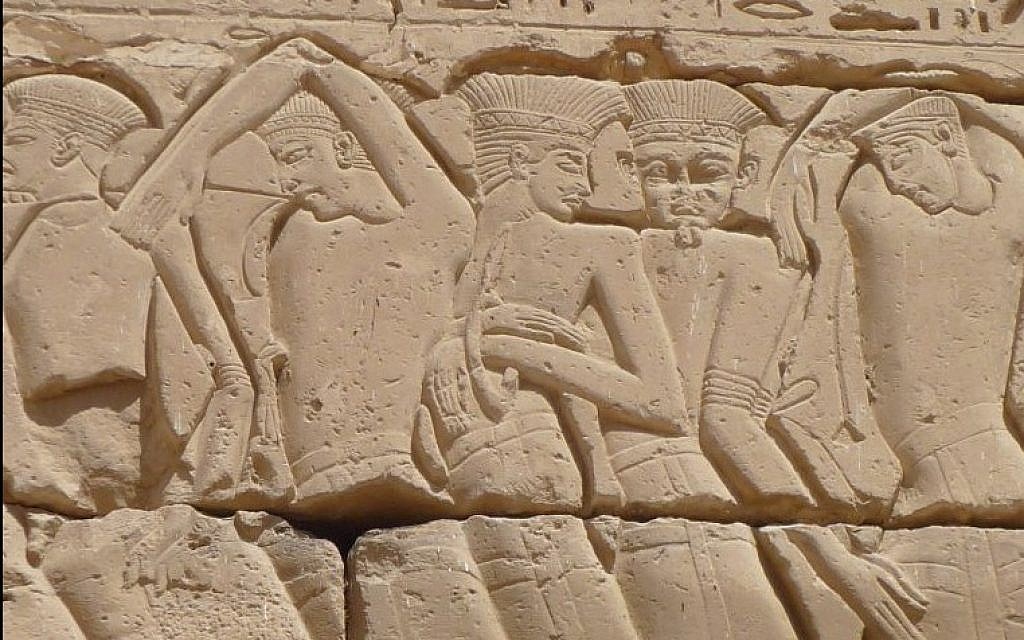
 I walked over towards the first pylon, its main entrance had now been sealed off,  faint relief’s show prisoners acquired during the battle of Kaddesh, I walked down the side of the pylon and  found myself at the  small  entrance  tunnel within the pylon, its dark staircase rose at a steep angle, a staircase to the heavens,  a square shaft of daylight from the sky above beckoned me upwards,  temptation was too much, I had to climb the staircase up to the top of the  pylon, at the top a bit of mountaineering was required  as the pylon is damaged, from here I could see the whole area around the temple, down the side of temple are the ruins of stables grain storehouses, and the apartments of priests and workers

The Rammessium mortuary temple was created to ensure that Ramses' name would live for eternity after his death, when the priests would make offerings for his Ka. Thousands of years passed and centuries of silence had shrouded the Rammessium in the silence of the desert, the ancient  words written on its walls were silenced, the priests were driven away,   the gods and Ramses’ were forgotten, then sadly the earthquake destroyed parts of the Rammessium,  I believe the exploits of Belzoni and Napoleon inspired the world once more and woke  Ancient Egypt from its slumbers, it is alive  again, and Ramses name will live for eternity his star has risen in the heavens once more and travelers  flock to this antique land again. As I stood in the courtyard  I tried to imagine how such an enormous    statue could have been erected in the first courtyard, a giant so large it emitted Ramses power and strength to the world, it must have been an   awesome sight when it had arrived from Aswan in one piece, it  stood taller than the seated statues of the Colossi of Memnon, which was probably another reason for its downfall it did not have the throne of two lands to counterbalance its weight and height when the earth quake struck.

In 1816 the Italian adventurer called Giovanni Belzoni arrived in Luxor, he had originally started his career as a strong man in the circus, when things became hard to earn a living by this means Belzoni grasped the chance to work in Egypt using his knowledge of hydraulics, when this also failed he then accepted work from Thomas Salt to track down and collect antiquities that Salt then sold onto The British Museum. When Belzoni arrived at the Rammessium he enlisted the help of one of the local village chief's, who provided him with men to help him pull the head of a statue known as the ‘young Memnon’ to the banks of the Nile, the young Memnon was one of two smaller seated statues of Ramses that sat in the second courtyard each side of the steps that lead into the hypostyle hall. When Belzoni arrived in Egypt there was no protection for the antiquities and the local village people were not interested in the ancient temples, so with payment for their labors they happily helped him to remove the head of the young Memnon.

Belzoni moved the head in the same way that the ancient Egyptians had completed all their heavy stone moving tasks. He laid the head on a sledge of rolling logs with the aid of pulleys. For three weeks the troop of eighty men pulled the largest known colossal head weighing seven and a half tons, and still they only covered two and a half miles. Belzoni became ill with sun blindness and the head was abandoned. When he recovered the locals considered him crazy as he wanted to continue with his plan to get the head to the Nile, for Belzoni the task had now become more urgent as he realized that his illness had set him back, and he knew that it would soon be time for the annual Nile flood. He convinced the chief to help him again, and triumphantly they finally reached the Nile a few weeks later where the head was put on a Felucca and sailed to Cairo to add to Salt's collection. Belzoni then went into The Valley of the Kings in search of more treasure.

As I walked across the courtyard another set of Osiris statues
loomed towards me in solemn silence, I realized all their heads were missing, and yet with their arms crossed holding both the flail and scepter they still affected me with their majesty and presence. A singular large head carved from granite appears to have dropped into the courtyard beneath their feet, it sits slightly lob- sided, and I stopped to gaze on the beautiful face of Ramses, the whisper of a smile touches the corners of a perfectly formed mouth.  I decided that the poet Shelley was wrong when he wrote in his poem ‘Ozymandias’ that the face of Ramses portrayed a sneer of cold command, with a frown and wrinkled lip, the romance of the period he lived in had created an impression of a king that was nothing like the face that gazed back at me, there was no sneer of haughty command that his poem described, so I smiled back at Ramses and I felt he acknowledged my affection. Standing there I suddenly realized that I wasn’t alone, an elderly attendant  had come to stand beside me, he then walked towards  the head, he pointed and gestured to my camera,  his hands telling me what his words could not, he created an imaginary frame with his hands around the head, all the time pointing to my camera, a large grin  then escaped on his face and the laughter lines crinkled around his eyes, ‘Action!’ he suddenly declared,  I was so surprised I had to laugh, it seemed so comical to find my own film director, come action scene camera assistant within the grounds of a temple, and so having taken my photo I followed  him with good humour  to see all that he wanted to show me.  We walked up the central staircase at the side of the osirid statues and in large relief on the wall before me Ramses kneeled at the feet of the gods Amun Mut and Khonsu, he was blessed as the Lord of a million years, beneath this scene are a row of his sons.

 My eyes were drawn to the corner of the relief, where the bold graffiti of Carlos viola Italiano 1820 is brazenly gouged into the stone, it reminded me of the signature an artist would put in the corner of his canvas. My new friend then guided me to the broken granite sitting statue that I had passed as I came up the steps, and pointed to graffiti carved within the cartouche of Ramses and I recognized the name Belzoni and the year 1816 had been cut into the granite between the cartouche of Ramses on the back of the statue, this was the same statue that Belzoni had come to the Rammessium to collect the head of the younger Memnon from. Its twin had just smiled at me on the lower courtyard; I turned and entered the final steps into the hypostyle hall, where further battle scenes are shown on the south east wall detailing the campaigns of Ramses showing the battle at the Fortress of Tounip and Dapour where Archers reign arrows down from a higher fortress and men clamber up wooden ladders for the assault.

The Egyptian campaigns during this period brought many slaves into the Nile Valley, they were employed in various services, and some were sent to the legions, some to the sea, some to royal palaces and others to work for the temples. The king’s name was branded on them to prevent their escape and assist recapture. It is considered that Ramses 11 was the father of the oppression and the father of the un-named princess who found Moses in the little papyrus barque among the rushes in the river. Moses eventually led the Hebrews out of the land of bondage to the land of promise under the reign of Ramses 13th son Pharaoh Merneptah 11 As I walked through the Hypostyle hall I arrive at the back wall to see one of my favorite relief’s, the beautiful Goddess Sheshat the inventor of writing holding the palm of years in her hand as she stands at the side of the tree of life, and draws a cartouche for the king in the presence of her husband Thoth the scribe of the gods. The god Amun Ra is seated and he tells Ramses ‘I make your years on earth last in unending numbers, I make your lifespan more secure than the lifespan of heaven remaining in your own temple. I write your name in the holy Ished tree with my own hand, I have proclaimed you king on my throne’.

As I walked towards the central doorway within the wall I spotted another piece of Graffiti naming Belzoni and underneath his name the name of Salt. I looked up to the dark painted ceiling was in awe as I as I looked at the heavenly barques passing through the cosmos with the gods of the sky and beautiful astronomical records.

During his long reign Ramses took eight principal wives, but Nefatari was his first and favorite among them, she was his chief queen until her death in about the 24th year of his reign. Nefatari bore his first son, and at least three other sons and daughters. The most outstanding tomb in The Valley of the Queens is the tomb that Ramses created for his beloved wife Nefatari, theirs was a story of love not duty, Nefataris tomb is vibrant with color, and above the entrance to the burial chamber Maat the Goddess of truth kneels with her protective outstretched wings, her royal cartouche is written down the side of the lintels. Nefataris tomb is in The Valley of the Queens-QV 66.

After Nefataris death, Ramses second wife Istnofret took her place, it was her son Merneptah that later became Ramses successor. Ramses had outlived many of his sons, Kent weeks the English archaeologist has re-discovered KV5 which is the largest tomb in the Valley of the Kings that Ramses began to house the remains of his many sons. The tomb was originally discovered by James Burton an English Egyptologist who mapped the first few chambers
Ramses died at about 92 years of age, which was very unusual , he had outlived many of his own sons, and  his Tomb had been prepared for  many years in the Valley of the Kings, and like many kings his mummy was not found in his own tomb but  hidden in the great cache of Royal Mummies discovered in 1881 at Dier El Bahari,  To protect   his mummy  from the threat of tomb robbers Ramses had been taken from the Valley of the Kings and hidden  within a secret tomb in the mountainside near Hatshepsuts Temple, thousands of years later  the Rassul  brothers, a family later noted for  tomb robbery discovered the cache.
In 1977   Ramses was flown to Paris where a Great Ramses 11 Exhibition was staged. The journey was arranged to offer the mummy the best conservation treatment possible as deterioration had been noticed, with the invasion of beetle larvae.  In the shimmering heat at Cairo airport the coffin of Ramses passed onto the plane whilst a guard of Honor saluted the King.  On arrival in Paris Airport Ramses was again greeted with a full presidential guard of Honor even though   he had been dead for nearly 3,200 years.

In the fields and undergrowth at the side of the Rammessium lie the ruins of a small chapel where a beautiful statue of the face of Merit –Amun was unearthed. The chapel is known as The Chapel of the White Queen, who was the eldest daughter of Ramses and Nefatari who also became one of her father's wives. Meritit-Amun was a priestess of Het-Hert  (Hathor) at the Temple at Dier El Medina, she held many beautiful titles and was obviously loved by her father to have her chapel so close to his mortuary temple. Meritit-Amun titles were; 

'The one who fills the forecourt with the scent of her fragrance',
'Superior of the Harem of Amun-Re' '
The Eldest daughter of the King and Nefatari with the splendid face, Magnificent in the Palace,
The beloved of the Lord of two Lands,
She who stands by her Master like Sophis is beside Orion, and
One is satisfied with what is said, when she opens her mouth to the Lord of the Two Lands'
Her tomb is in the Queens Valley no 68.

Riding away from the Rammessium Mortuary Temple I decided to stop at the Rammessium Rest Room to escape the heat and quench my thirst with a drink.  I had discovered that the restroom is owned by the Abd Rassul Family, whose forefathers were the tomb robbers that had discovered the famous cache of Kings and royalty at Dier El Bahari at the side of Hatshepsut’s mortuary temple. Regrettably tomb robbers have the same fascination for me as Cornish smugglers, I know it is wrong but their secret lives still entice me.This is my painting of Ahmed Rassul with his mother , daughter and granddaughter outside their tomb home, the painting was taken from an old black and white photo


 went into the Rammessium rest room and looked at the memorabilia on the walls and was drawn to the face of a young boy,  in the poignant black and white photograph a young boy wore around his neck one of the necklaces of Tutankhamun, the boy had worked for Howard Carter  as a basket boy when they emptied the treasures  from Tutankhamuns tomb , when I saw this photo I forgot about the treasures within the tomb, because this one photograph finally  emphasized the reality of a situation that had never really sunk in, that Tutenkhamun like this teenage boy wearing his necklace, was infact also a child  who had ruled a great civilized nation when other countries were still living in mud huts. The young boy in the photo became a sheik and was known as Sheik Abd Rassul, and until he died he told many tourists the stories of his grandfather the tomb robber, and his experiences of being part of the most exciting discovery of all time with Howard Carter. I was so inspired by this old black and white photograph that I decided to paint a canvas of the boy, and on a later trip to the Rammessium Temple I went back to the Restroom to give them my painting. As I entered the Rest room a man stood up in delight and declared ‘That’s my Grandfather’, ‘O’h good’, I said’ I am glad you recognized him ‘, I took a photo of the boy but lost it whilst working on my painting, so most of the portrait was from my imagination, but I think the glory of Tutankhamun is expressed with the canvas of the finished painting as the color regally blazes off from the canvas. Mohamed excitedly showed me photographs of Howard carter and Lord Carnarvon along with a photo of his great grandfather the tomb robber Ahmed Abd Rassul who had actually lived in a tomb with his family.

On a more recent visit to the Rammessium Temple, a man in a djellebar attached himself
to my brother and I as we made our way through the temple, most of the time I  find these men irritating as most of them can only speak Arabic, their knowledge about the temple they work in is often poor, and so I am not actually sure what their real function is, all they appear to do is try to encourage you over to show you something that they don’t really understand, and once you stand there and stare at what they are showing you the inevitable request for baksheesh is prompted. I must admit though as irritating as it can be, sometimes it can have an advantage, and on the trip I took with my brother through the Rammessium, I have never been so excited or privileged to see something as exciting before. The attendant encouraged us to follow him and he walked towards the arched grain and store rooms, archaeologists were working in the land at the side of the Rammessium, and it was obvious they had been working here too, as we passed several deep holes, eventually we arrived at the side of a mud brick wall and a hole that was lightly covered in corrugated iron, he lifted the sheet up and behold, two frail bodies lay in sarcophagus beneath us, I was overwhelmed, one had the body of a small infant, its skull shone in a small shaft of light, the larger body was still swaddled with its wrappings, debris surrounded them, it was the highlight of ten years of visiting Luxor to see these mummies and experience probably the same thrill that the archeologists had on discovering them. Every time I visit Luxor I see something new that I never noticed before even if I visit the same temples.

The Gods Wife of Amun


The Mortuary Chapels of the
GODS WIFE of AMUN at Medinet Habu


 Ramses 111 had been one of the last great rulers of ancient Egypt, later pharaohs struggled to maintain order and the country was split once more, dividing Egypt into two kingdoms again, with one king ruling Upper Egypt and another king ruling Lower Egypt. During the 25th dynasty Waset maintained its own individuality and was ruled by The Gods Wife of Amun, these women were the daughters or sisters of the opposing kings, and their rule was a political as well as a religious position. Waset (Luxor) was the middle ground between two kingdoms so each king maintained power through his daughter or sister therefore avoiding war and unnecessary hardship, The women were revered within Waset as they were considered the living mortal wife of the god of Amun and these particular Gods wives had taken a vow of celibacy which promised no threat of another male claim to the throne. The Gods Wife owned about 2,000 acres of fertile land in both the delta and Upper Egypt and received bread oxen geese and yields from the fields from the Priests of Amun, A small row of mortuary chapels are set back on the side of the courtyard as you come through the Migdol gateway. These mortuary chapels belong to Shepenwepet 1 who was the daughter of Osorken 111 a king of the Libyan invasion, Amendiris 1, a Kushite princess who was the sister of the king Piankhy the founder of the 25th dynasty. Piankhy made a religious pilgrimage to Waset and convinced Osorken and Shepenwepet to adopt his sister Amendiris as heir and successor to the title of Gods wife of Amun. I walked over to visit their chapels before I left the precincts of the temple grounds.  Above the lintels of the doorways the ‘appeal to the living’ is written, it encourages people passing through the door to repeat the offering formula for the Ka’s of these powerful women. An offering formula ensured that after their deaths a person would not be neglected, if offerings are not actually taken it is considered that the words spoken would be enough to sustain the Ka’s of these mortal celibate wives of Amun. You have to think of ‘the appeal to the living’ in the same way as a gravestone reminds you to visit an ancestor or friend to leave them flowers, telling them your worries and expressing your love for them, so as I passed through the door I asked Amendiris to accept my spoken offerings of food wine linen incense and water as gifts for the Ka of her eternal life.


Inside the chapel I was greeted with a deep warm glow of golden sand coloured stone and a strong, yet elegant image of Amendiris walks across the wall wearing only the plumed headdress of Amun, where she is performing an ancient ceremony known as the driving of the four calves and the treading of the grave. In her left hand she holds a staff, leashed to the staff are four calves, as a farmer would till the earth to enhance the fruitful growth of his new crops, Amendiris is symbolically re-enacting s the farmers yearly ritual in her burial tomb with four calves who tread the earth so that they like Osiris the god who rose again from death to be reborn would keep Egypt fertile for another year, at the end of each leash dangles the key of life enhancing the wish for new life. In her right hand she carries a stick to drive the calves across the burial ground. The Egyptian faith encompassed all the forces of nature and I feel that this expressive coffin text helps to understand the beauty and simplicity of this symbolic act that Amendiris portrays to combine the acts of nature with the Gods and the universe.

Whether I live or die I am Osiris,
I enter in and reappear through you,
I decay in you,
I grow in you,
 I fall down in you,
I fall upon my side.
The gods are living in me for I live and grow in the corn that sustains the Honoured Ones.
I cover the earth;
Whether I live or die I am Barley.
 I am not destroyed.
I have entered the Order,
I rely upon the Order,
I become Master of the Order,
I emerge in the Order,
I make my form distinct,
 I am the Lord -of the Chennet
I have entered into the Order;
I have reached its limits. . .

Medinet Habu - The Mortuary temple of Ramses 111


MEDINET HABU
The Mortuary Temple of Ramses 111

Leaving the ticket office I rode towards Medinet Habu, jostling and bumping along like a rally driver over rough terrain I attempted to avoid all the pit holes  along the edge of the desert, to my right the black tarmac road  weaved its way towards the Valley of the Queens where it cut through the base of the Valley like a flowing river  and  arrived at the entrances of the tombs of the two young sons that Ramses 111 had adored and was shown to escort through the perils and gates of the underworld himself.

My rally ride eventually joined the road that swept around a blind bend arriving in a wonderfully relaxed and quiet corner of Luxor; I stood beneath the unusual Migdol entrance of Medinet Habu, the Mortuary temple of Ramses 111 who was considered one of the last great rulers of Ancient Egypt.  During the Middle Kingdom period this area was believed to be where the Ogdoad, the four pairs of first primeval gods, were buried.


The Egyptians believed that before the world was formed, there was a watery mass of dark, directionless chaos. (Like the sky at night) In this chaos lived the Ogdoad, four frog gods and four snake goddesses of chaos. (we know that during the first act of creation of a baby the sperm appears as a snake) the ogdoad represented  balance in infinity, they were thought to have helped with creation, then died and retired to the land of the dead where they continued to make the Nile flow and the sun rise every day.


The ancient Egyptians believed that the spirit of a person (the Ka) came into being at birth, and was intimately linked to the physical body during his eternal life after death, when it would require sustenance of food and drink. At the mortuary temples on the west bank the priests presented the Ka statue of the deceased king with offerings to satisfy his needs, these temples were also used also for festivals during the king’s lifetime.  The temples could be considered as books that were written in stone to inspire the nation of the king’s courage and deeds in his lifetime.

Every temple has a different feeling; Medinet Habu is peaceful, although it has a detailed and fearsome war record showing the battles Ramses fought with the Sea people. The temple has been restored and is a pleasure to view because the majority of tourists head in droves to swamp the more famous areas of Hatshepsut’s temple and the Valley of the Kings. People are unaware of the exciting history that is recorded on the walls of Medinet Habu relaying the king’s desperate and final victory   during an invasion of the sea people. Happily for me   I found myself  virtually alone, surrounded by peace and a small measure of solitude to contemplate the history within.


As  I walked between the  defensive walls of the Migdol   wrapping around each side of me,  my eyes were drawn to the high windows of the Kings harem, its deep fortified walls rose high above me traveling before me to cross the top of the  shaded portal gateway,  I imagined the king  standing in the window above me, looking down  from the windows of his harem, symbolically defiant as his foot rested on  the head  of one of the prisoners  protruding  from the base of the windows.   As I emerged through the gateway I was temporarily blinded by the sun, I had to shade my eyes whilst they adjusted to the brightness in this vast open courtyard, and then my attention was immediately demanded by the strong central main position of the temple that proudly stood before me, the pale stone pylons majestically rose from the ground and seemed to reach the edge of heaven in a beautiful clear blue turquoise sky.


 Far away broken mud brick walls traverse around the edges of this courtyard dividing this small city of Habu from the desert they were as broken and trampled as the real threats of invasion that had been endured during the early years of Ramses 111 reign when the fortified walls of Medinet Habu then became a sanctuary of safety for the tomb workers who lived nearby at Dier El Medina.

Ramses had come to rule when there was unrest in the Mediterranean countries, the Trojan War was being fought, and many people were displaced and seeking new countries to settle in. Initially the first few years of his rule were quiet and so he strengthened his position. In the 5th year of his reign the Libyans tried to force there way from the desert area into the fertile lands of the western delta. Ramses took his army and quickly squashed the Libyans and anyone left alive was taken into slavery.   I n the 8th year of his reign the Sea People marched down through Syria they were accompanied by a large fleet at the Delta, they came with their families and all their possessions obviously intending to settle in Egypt’s fertile Nile lands, Ramses drove off the main force and defeated the enemy fleet in the engagement fought at the Delta.


 His victories are written all over the walls inside the temple, pitiful enemies are bound by the neck and wrists, and then dragged around on a leash by him, their tribal leaders forced to prostrate before him, whilst his court celebrate releasing doves in the air that will fly to the four corners of the earth to proclaim his victory and kingship. Vast sea battles are detailed on the exterior walls of the temple, they show his army battling in the chaos of the sea, and arrows fly across the walls recording the onslaught and chaos, lifeless bodies dangle from the war barques helpless bodies pierced with bloody arrows. Soldiers leap in droves from the boundaries of their boats where fierce fighting ensues, bodies are hacked by the swords as the mighty Sheridan wearing metal helmets with horns sweep into the fray, they are mighty adversities and fearless in this battle, where they are the enemies of Egypt.


Arriving inside the first courtyard are seven square pillars, In front of these pillars  stand seven sturdy  Osiris statues of Ramses, the statues wear the plumed Atef crown, which reminded  me  of  Japanese samurai , the war  lords and  rulers of clans who fought for   tribal dominance and land, they were revered and feared within Japan for centuries, I felt that the statues inspired a military  dominance to this  courtyard,  the fantasy of my imagination made me weary of them, I fully anticipated their awesome power to erupt  and boulders crash over  my head as their giant frames came to life, woken from a solidified spell that had been cast over them turning them to stone.  I held my breath as I almost feared there resurrection in this confined space. Ramses 111 had taken his inspiration for these Osiris giants from similar statues that Ramses11 had created within his second courtyard at his mortuary temple known as The Rammessium, although I personally feel the statues at the Rammessium reflect a calm and peaceful aura compared to the military dominance and authority of these giants enclosed within the boundaries of a small enclosed courtyard. Backing  away  slowly  I edged my way across to  the opposite side of the courtyard towards the circular columns on which the king holds  groups of  prisoners by  their hair ,  in his left hand he brandishes the hedj club ready to strike them. ‘I bind them all for thee gathered in thy grasp’ he tells Amun. This symbolic act shows his supremacy over his enemies, assuring the Egyptian people that he can bring order once again where there has been chaos. Ramses111 fought the Philistines Sardinians Cretans and the Danu.

Unlike the armies we have today Ramses would pay his soldiers after a battle according to how many men they had killed , so they would brutally chop off the hands or penises of their enemies, these grisly trophies   would ensure their reward from the king. On the inner wall behind the round columns, rows of scribes, there heads shaved wearing their simple white robes of purification , calmly and methodically count and record these grisly spoils of war,   from the baskets of blood dripping hands that are  pilled high waiting to be emptied and then counted.


On the east wall  Ramses rides back from the battle triumphant in his war chariot, Amenhikhopeshef and Khamwese his sons and Royal Fan Bearers  proudly walk behind his chariot, to add further to my grisly shock  of the baskets of hands,  looking closer at the  wheels of the chariot , I realized there was something not quite right, and as I stared at the image I realized that  Ramses had leashed two  unfortunate prisoners  to the undercarriage of his chariot by their ankles and  arms. Shocked by this image I felt that I had learnt new lessons on the brutality of ancient war practices, forget the Geneva Convention, War in this era was domination power and brutality where only the strongest survived.


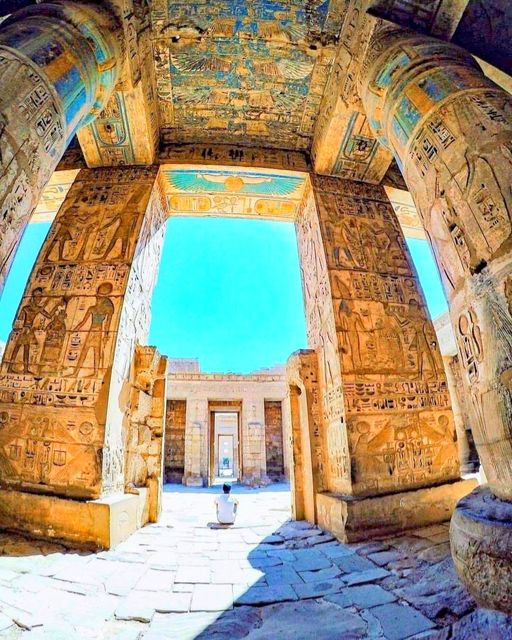
This photo is taken from underneath the tunnel doorway into the courtyard, the ceiling always shows the kings name in hyroglifs, with the signs for beautiful god,life,son of Amun Ra, along with this we can see the sun disc with wings. The symbolism of the winged discis always shown on temples and tombs on ceilings or doorways, as it expresses the incarnating spirit of the human soul in birth and death. The sun disc is the emblem of the human soul and the wings give it flight. By using this symbol on ceilings and doorways where we enter or leave, it reminds us that our soul only has a temporary residence within the human body.

The Hypostyle Hall at the rear of Medinet Habu creates a barrier between the outer courts of the mortuary temple and the Inner Sanctuaries and temple treasury rooms. In the hypostle hall only the broken stubs of columns remain, and the area is interspersed with the broken statues of Amun the father of the king, Maat the Goddess of Truth and Justice, from whom he would learn the qualities needed to be a good ruler, Thoth the God of Wisdom, who will write the magical words on the walls of his temple to record his earthly deeds and justify his reign, Ptah holding his broken djed staff strength and stability, and finally a statue of the king himself.

Ramses 111 ruled for 31 years, the cartouches on the walls at Medinet Habu where the name of the queen would normally appear have been left blank, unlike some kings Ramses obviously was not a romantic king inspired with the love of a wife, but he obviously adored his sons. One of his sons Amon-Hir-khopshef died as a young boy of about 15 years old, he was a royal scribe a cavalry commander a royal fan bearer and a Superior of The two Lands.  Ramses must have loved his son greatly as he buried him in a stunningly colorful and beautifully decorated tomb within the Valley of the Queens QV 55; his son’s tomb is one of the most popular in the valley.  His mother was so distressed by his death that she miscarried a baby, and the small foetus is now in a little glass coffin within his tomb.

Towards the end of Ramses 111 rule, a Lower wife Tiy was found to be the main culprit in a death plot against Ramses; she had hoped to see her son Pertwere succeed to the throne. A  priest who practiced the arts of  magic created wax figurines potions and wrote magical spells , In ancient Egypt words were magical, and had the power to evoke the  of power  life and death. The spells cast against Ramses and the black magic did not kill him unfortunately for the conspirators of this devious plot, their intentions were considered as deadly and as serious as an actual physical assault on Ramses, the magic invoked was as terrible a threat as trying to cut him down with a sword. Thirty conspirators of the harem were put on trial, they were sentenced to death and told to commit suicide in front of the court or in their cells, after their trial, ten judges also faced trial for having taken meals with the accused during the trials, they were condemned to have their ears and nose cut off. Recently Ramses body has been put through a scanner and it was discovered that his throat had been cut.
Ramses also considered tomb robbery a very serious offence and it was at Medinet Habu that the Kenbet (court) dealt with the criminals who violated the tombs of the kings. The scribes recorded the trials and confessions and the records were then hidden for safe keeping.  Punishment for this crime was to have the nose and ears cut off and to be impaled on a stake on the mountain side.


Apart from his mortuary temple built at Medinet Habu, Ramses 111 had a tomb excavated in the Valley of the Kings. The Scottish traveler James Bruce was the first known European to enter his tomb in 1768. He named it 'The tomb of the Harpists' after the paintings decorating the walls of one of its side chambers of blind harpists. The tomb is KV 11.


The Colossi of Memnon - They Sang at Dawn - Eos who wept for the death of her son Agamemnon


The Colossi of Memnon


The Colossi of Memnon are two enormous statues sitting on the throne of two lands rising to a height 66ft, they originally flanked the entrance to the Mortuary Temple of Amenhotep 111, and the remains of the temple are in the process of being excavated. Amenhotep 111 also created the large Hall of Festivals at Luxor Temple, and his tomb was found in the Valley of the Kings by soldiers of Napoleon's expedition to Egypt in 1799. 

His wife Queen Tiye was not of royal blood, unusually she was the daughter of a chariot officer; both his wife and his mother Mut-em-ua embrace the sides of his legs. These two statues sitting alone on the fields became famous during the Greek conquest of Egypt when the right statue was known to sing. The Colossi face East and the River Nile, with a backdrop of the Theban Mountains and the Tombs of the Nobles. 

The Colossi represent Amenophis 111 of the 18th dynasty, who was the father of the heretic king Akhenaten. The left statue is in a better condition than the right one, the decoration on the base of the throne shows Hapi the God of The Nile, he is an unusual God because although male he is represented with female breasts, and a flabby belly of a woman who has seen child birth, his presence on the colossi would be to guarantee the fertility of the cultivated fields when the Nile floods. The Greeks named the right statue after the legend of Memnon who was the son of the Titan Goddess Eos. Memnon had been slain by Achilles during the Trojan War and the Greeks believed the sound that came from the statue in the morning was Memnon greeting his mother Eos who wept for the death of her son.  Graffiti carved on the foot of the Memnon translated reads ‘From Trebulla. Hearing the Holy voice of Memnon I missed you, O my mother, and I prayed that you might hear him too.’


 Over the ages science has taken away belief and scholars explain that the Colossi was cracked during an earthquake and the singing is now known not to be the singing of gods but  the cause of  the rock having cooled during the night, and once the rock heated up again at sunrise it caused the sounds to emit from the cracks. From a distance the colossi look unimpressive due to their deterioration, and  most travelers get off their bus and stand at the edge of the car park  to take their photos, then they all swarm back onto their buses again unaware of the interest that the Memnon can inspire, do not be discouraged  by the appearance and layers of wreckage of the colossi because if you walk over and stand beneath the mighty statues of Amenophis, on closer  inspection the right colossi   has the most interesting graffiti that has been etched into the stone of it’s legs from the many travelers throughout  the centuries to commemorate that they heard the sound or paid homage to the Memnon, words are written in  Latin  Greek English and  the French  soldiers  during Napoleon’s  attempted conquest  of Egypt, some of the etched comments  written ;  Camilius, hora prima semis' audivi Memnoni. Which means, ‘At half-past the first hour I Camilius, have heard the Memnon’ It is believed that Camilius was an early second - century Roman governor of the province of Egypt.

I would love to climb a ladder armed with large sheets of tracing paper and gently rub the inscriptions out onto the paper to be able to decipher all the comments from the travelers that have come to the Memnon over the centuries creating a book on the graffiti of the Memnon, it is one of the largest and most unusual autograph books written in stone that I have ever seen.

The Roman Emperor Hadrian visited the Memnon with his wife the Empress Sabrina and his court, in their company was a poet and companion of the empress Julia Balbilla, she had her own graffiti carved onto the foot of the Memnon which translated  reads: ‘I Balbilla, when the rock spoke, heard the voice of the Divine Memnon or Phamenoth. I came here with the lovely Empress Sabina. The Course of the Sun was in its first hour, in the fifteenth year of Hadrian’s reign on the 24th day of the month of Hathor, I wrote this on the 25th day of the month of Hathor,

The colossal statues of Amenhotep 111 were originally hewn out of the quarries at Aswan, and eight ships were built to transport them up the Nile to stand at the entrance of the mortuary temple on the West Bank of Thebes.  Only the foundations remain of the temple of Amenhotep now, earthquakes and the Nile floods left it in ruins, and later pharaohs stripped it down for their own temples, only the Colossi indicate its former entrance. Behind the colossi archaeologists are working in the foundations of the mortuary temple I noticed that they have erected the huge Stella that recorded the temple and how it was made for Amun. The archaeologists have found many statues and artifacts over the last 15 years and they are wonderful to see.


Luxor Museum


LUXOR MUSEUM
Discovering Akhenaten


Having  spent the morning at the mummification museum I decided to use the evening to go in search of  Akhenaten, this can be rather difficult as his works were systematically destroyed after his death, no statues of this heretic pharaoh can be found in any temples in Luxor, although the tomb of Ramose offers a glimpse of Armarna art with the king practicing his vision of one god the Aten before he left Weset (luxor) to create his new Kingdom in a completely barren and deserted place that he named Akhetaten, the horizon of the Aten, now known as Armarna, this was also raised to the ground after his death, so unless you are an archaeologist there is only one definite place to find Akhenaten whilst on holiday and that is at Luxor Museum. Akhenaton had been a pharaoh like no other, his whole concept of life and spirituality was on a completely different level from any king that has ever ruled Ancient Egypt, he believed in one god two thousand years before the birth of Jesus Christ, and so I wanted to look on the form of Egypt’s most unusual and revolutionary pharaoh, to achieve this I knew there was only one place that I would be able to gaze on this metamorphous of a mortal,
so I jumped in one of the many caliches that were parked up at the back of Luxor temple and asked the driver to take me to Luxor Museum. Once the driver had negotiated the busy road crossing, I relaxed into my seat and enjoyed the slight breeze that enlivened my senses as the unusual white horse pulling my caleache trotted confidently down the Corniche,  its vibrant mane and tail of  outrageous flaming orange  flew with the breeze, the owner had radically  drawn attention to his horse by dyeing its white hair with henna, this  had to be the most noticeable horse in Luxor, and something about this striking horse   stirred memories from my childhood. I smiled as the memories surfaced again and I remembered scenes from the  film  ‘The wizard of Oz’  where  the  white horse had  triumphantly taken Dorothy  into the Emerald City, and  like a  chameleon the horse had constantly and vibrantly changed  its colour .

As we passed the side of Luxor Temple I was inspired by its vision of radiance and light, its pale golden columns of the Festival Hall of Amenhotep 111  glowed against the early evening deep blue  sky, the floodlights seemed to increase the size of the columns almost helping them to touch the heavens, and then  I remembered an evening walk I had taken through the Temple with Hamde ,  who had worked in the temple for seventeen years, he told me of the ancient beliefs that the stones of the temple had a soul, and that when darkness falls the light of the stars illuminates them again, and they are  filled with the luminous Ka’s of the Pharaohs, then like Nut the god of the sky who comes to meet her husband Geb the god of the earth each evening, the stars came down to earth to fill the ancient containers in the temple with incense and myrrh. The columns had a stream of light reflected through them, and Hamdes beautiful story seemed so real, I looked at the Columns and I felt the magic of the temple and I was so grateful to be alive and experience my emotions that had become so entwined with this ancient culture.

The glow of the temple fell behind us as my horse confidently trotted down the Corniche and I knew that I was experiencing my own special piece of magic that night. Progressing down the Corniche the driver rattled the bells of the  caleache,  cars hooted and tour buses shunted and shuffled, they dropped weary but exuberant tourists off from their  excursions, deftly my little caleache weaved its way through all the bustle of traffic and I observed a migration of people disappear down the steps  leading them to cross the longest river in the world, the river that gave life to Egypt and its amazing ancient civilization,  whilst modern Luxorians jostled their way onto the  crowded ferry they lived their ordinary lives untouched by the splendor around them and their boats continued to cross  in a never ending flow over this awesome river  of life. 

My caleache passed several elegant cream colonial buildings containing memories of yesterday from archeologists and the history they had woken up, we passed the Mummification museum that was discretely hidden from view like a tomb itself, its staircase descended underneath the depths of the Corniche; from this point the road gradually became quieter, and shortly after the horse pulled up outside Luxor museum. To my surprise the museum looked completely out of place, it was an expanse of modern looking embossed concrete, and it suddenly reminded my brain of what century I was actually living in, the driver wanted to wait for me but firmly I told him no as I wanted to relax in the museum and take my time, and I had no idea how long I would be. It is never a problem trying to find a taxi or caleache in Luxor, the problem is more of how to loose one, they want to stick to you like glue. Climbing down from the caleache I surveyed this large modern building with a plain strip of grass before it, and a small black granite striding statue of Tuthmosis. I collected my ticket and passed through the security entrance where I was guided into a small cinema to watch a short film  that described the return to Luxor of two warrior kings, Ramses 1 and Ahmose 1, their mummies were on special display in the new military wing that has been created within the museum. Having watched the video I couldn’t wait to see them. I humbly regret to say that most of my visit from that point was a blur until I stood outside the room of the first warrior king, and so I skipped a lot of the initial collection, deciding I would go round again after I had satisfied my curiosity of visiting the kings.

Climbing up a step and passing through the entrance I arrived in a small room where every visible surface was painted black and the ceiling was so high it was a reminder of the vastness of eternity; modern artists had not needed to impress the gods, but to simply remind us that we are standing in the presence of a King. To my surprise the frail body of Ahmose 1 laid within a glass case in the middle of this small room, and it was hard to imagine him as a warrior, but then I remembered how small David was and yet he had slain goliath in the bible, and so I decided it wasn’t sensible to let the small frame of this king influence my first impression. As I walked around his glass coffin I was drawn to his amazing battle axe displayed behind a glass recess in the wall, the power of this axe convinced me that it could imbue any man with an indomitable strength of will both in life and battles, and I believe Ahmose had those qualities. His father king Seqenenre Taa had been killed with horrific blows to his head fighting the Hyskos, who had been driven from western Asia into Africa by instability and famine; they had settled at the delta and ruled northern Egypt.  After the slaughter of Seqenenre Taa in battle, Khamose the eldest brother of Ahmose became king and led his army to face the hyskos, he was also killed in battle, and so the title of King descended onto the shoulders of a young ten year old boy who became Ahmose 1, ‘The Moon is born’. After the death of her husband and eldest son, Queen Ahmose Nefertari guided her youngest and only son Ahmose 1 to become a great king, a king that united Egypt’s two thrones once more.
                                                                                   

I do believe that a man can become great with the influence of a strong woman; Eleven years after the slaughter of his father and brother Ahmose also went to battle to seek his revenge for their deaths, he marched his army into Avaris and finally defeated the Hyskos driving them out of Egypt, He then traveled south with his army and defeated the Nubian king, where he seized all the gold mines and reasserted Egyptian power and laid the foundations of the New Kingdom. Ahmose became known as the Glorious liberator, the Avenger of five wounds, the Unifier of Egypt and Great Conqueror, he presented his ceremonial battle axe to his mother Queen Ahmose Nefertari to celebrate the victory. Ahmose 1 ruled for twenty five years and his mummy was found in the cache at Dier El Bahari along with his father and many other great Kings of the New kingdom era. Leaving the sanctuary of Ahmose I then went into the next room to meet Ramses 1, who was not actually of a Royal bloodline when he became king. His official titles before becoming king were Master of Horse, Commander of the Fortress, and Controller of the Nile Mouth, Charioteer of His Majesty, and King’s Envoy to Every Foreign Land, Royal Scribe, Colonel, and General of the Lord of the Two Lands.  Ramses became one of the later kings after all the turmoil that Akhenatens reign had created within Egypt. After Akhenatens death Smenkaare ruled for a year then the boy child Tutenhaten grew up as a king, and under the guidance of his Vizier and chief advisor Aye he returned to Waset changing his name to Tutenkhamun and reinstated the temples of Amun, after a  ten year rule, Tutenkhamun died leaving no heir to the throne, and Aye took control , probably Aye  wanted to feel assured that Egypt would retain its strength and position again after years of turmoil so on his death he transferred power to the Army, and General Horemheb became king, who obliterated any traces of Akhenaten and the Armarna period that had damaged the strength and prestige of Egypt, a position he had been trained to create. When Horemheb died he transferred the throne to his general Paramessu who became Ramses 1. With this turn of events Egypt was now in safe hands once more, the Black land was settled and stable once again, and although Ramses only ruled for two years his son Seti 1 and especially his Grandson Ramses 11 held long and secure reigns that created a memorable era for ancient Egypt. Ramses 1 arrival at Luxor museum followed an extraordinary tale of tomb robbers and eventual saviors.

Across the river at Dier El Bahari in 1888 the Rassul brothers, local tomb robbers had eventually admitted that they had found the secret hiding place of many great kings. It is considered that Priests removed the Kings from their own tombs to protect them from Tomb robbery many centuries ago. When the cache was found at Dier El Bahari The mummy of Ramses 1 was missing although his coffin was found with the rest of the kings. It appears that the Rassul brothers had sold Ramses1 for seven pounds to a Canadian physician named James Douglas who had acquired the mummy for the owner of a museum at Niagra Falls. Over a hundred years later In 1980 a German Egyptologist visited the museum and recognized the features of Ramses the great as he looked at this mummy, he was aware that the mummy of Ramses 1 had been missing from the cache, and also this mummy had its arms crossed and its hands appeared to have been grasping what could have been the symbols of royalty which indicated that it was a royal mummy. In 1999 the Niagra falls museum closed and the mummy was sold to the Carlos Museum for two million pounds, the museum arranged for cat scans and compared the details with the mummies of Seti 1 & Ramses 11 and were convinced that they had in their possession the mummy of Ramses 1, and with this knowledge they generously offered to return the ‘lost’ king to his homeland, and so Ramses arrived at Cairo airport, his coffin was draped with the Egyptian flag, and received a military escort, eventually plans were made to return him to the place of this throne and burial in ancient Waset, now modern Luxor, from Cairo a flotilla of boats escorted him along with Ahmose 1, up the river Nile to a military celebration and welcome that waited for them on the east bank of Luxor, where their coffins were then driven by horse through the town on a special white barque to a reception at Karnack Temple and then their final resting place within the new wing specially created for them at Luxor Museum the kings had arrived home to jubilation once more.


I left the room of Ramses and headed towards the highest level of the museum to see Akhenaten. I wondered who was this king that had created so much turmoil within a society that had been dominated by their beliefs of many gods and the Priests of Amun for thousands of years?
 Akhenaten was one of the sons of Amenhotep III, the pharaoh who had created the largest festival hall at Luxor Temple and whose colossal statues are known as the Colossi of Memnon, they sit alone abandoned at the side of the fields of the western shore, now only the foundations of Amenophis’ mortuary temple remain behind the lonely statues, and in the desert the scattered remnants of his palace can still be found, this huge palace was possibly where Akhenaten grew up. The palace area today is known to the local s as Malquata, which means the ‘place of debris’, Amenophis had named it ‘The Palace of the Dazzling Aten’, he created a harbor in front of the palace that from its place in the desert it still gave access to river Nile, so that he could sail straight from the palace in his golden Barque that was called ‘Aten Sparkles, obviously during the reign of Amenophis the Aten was beginning to rise in importance.
During his childhood Akhenaten was known as Amenhotep, he was never included in any festivals or ceremonies along with his family, he was a hidden child, excluded from the royal circle, rejected, possibly because of obvious signs of an illness that royalty would not accept, but yet his mother Queen Tiy showered him with her love regardless of the reason for his exclusion. His older brother Tuthmosis was the heir to the throne, but when he died suddenly, a new heir was needed and Amenophis was finally exposed to the people as the new successor to the throne.


I stood beneath his statue and was drawn by the hypnotic stare from  his elongated Asian eyes that viewed me from above , his  face was long with unusually broad cheekbones and a high forehead, a strong masculine jaw  fought against the supremacy of his wide and sensuous mouth that pouted somewhat, I felt that he would have known my innermost thoughts in life, I was un- nerved by his steadfast probe of my soul, never had a pharaoh been portrayed in such an unusual  manner before, his deep sensuous lips reminded me of the African race, his long face with highly pronounced cheek bones suggested European and his eyes suggested Asian, his face was a confusion and seemed to portray a man  possessing the features from all the four corners of the earth within one race, his athletic  arms and long slender fingers grasped the crook and flail firmly, but there was no impression of the raw brutality strength or power from  within his body that previous pharaohs had amplified, he was an enigma, a man whose body portrayed both male and female characteristics with his sweeping wide female child bearing hips,  his mind held the key to his power and his strength, the wealth of his position and centuries of belief that the pharaoh was a living god fueled his defiance of the priests of Amun to eradicate their powers and install  his chosen God the Aten to rule supreme, like a despot he blindly pursued his belief and forced his will over others, but his will  was only as strong as his own mortal life and his beliefs and suppression of the priests of Amun then ended with his mortal  life.


I left his steadfast gaze and followed the small pieces of talatat across the wall, Akhenaten had initially created a temple at Karnack that he dedicated to the Aten, and to fulfill his usual rapid need for renewal he used these small slabs of talatat to decorate his temple. Pharaoh Horemheb had been an army general during the reign of Akhenaten, after his death he destroyed the remains of Akhenaten's Sun temple and used its remains to fill his 10th pylon.

All the pieces of talatat that could be found to match, like a jigsaw have been pieced together again to create a small scene from within one of the Sun Temples that Akhenaten had created outside the eastern gate of Karnack Temple. He named his main temple Gempaaten which means “The Sun Disc is found in the Estate of the God Aten",  there’s defiance for you and a snub to authority, his temple had no roof and was created in the same style that his father Amenophis 111 had made the  festival hall at luxor temple, its offering tables were exposed to the warmth of the rays of the Sun,  the opposite  of  the dark secretive and covered chambers that had been created for centuries of worship in the temples of Amun. A special house within the precincts of Karnack contains the remains of the small pieces of the talatat .It is  almost like a  library for  the privileged where only the chosen few are allowed to have a glimpse of all the broken remains of Akhenaten's rule. In time someone will come that can put all the pieces together and recreate Akhenaten's dreams once more. Many layers of history have tried to destroy and eradicate this most unusual pharaoh, a man of peace, a man who made his own rules and defied the priests of Amun, a king not interested in following the traditions of dominance,  a man  that was eventually  broken by the overwhelming forces against him, enemies on his frontiers and a plague within his Capital that took the life of two of his beloved young daughters, his hopes were diminished and after his death his religion and the sanctuary he had created at Akhetaten was abandoned by his people,  the lonely life he had lead as a child, and his vision of one god, the Aten was rejected, he had brought Egypt to the brink of economic disaster with his non violent policy and his life of seclusion, his only interests in life had been the love of his wife Nefertiti his children and the worship of the Aten. Regardless of his faults   I admired him for his determination to stand up for his own beliefs and for the obvious love of his wife and daughters; he had tried to create a haven of peace within a country that needed the wars and suppression of its neighbors to survive. Akhenaten was a rare pharaoh indeed and was not afraid to be shown in the tender embrace of his family something that no other pharaoh has ever been portrayed for, a man of the family, a child that had begun life as an outcast he blindly soared to the heights to live his dreams. Sadly his dream had broken him; he tried to change too much too soon. I sat and stared at his face for a long time, was this really him? Had he been as honest in his strange portrayal as he had been as open in is love for his wife and daughters? I sat and reflected for a long while, and then I left with the memory of his unusual face in my mind, as nothing else in the museum could compare to this enigma of a pharaoh.