Showing posts with label Hieroglyphics. Show all posts

Thursday, 4 March 2021

The Tomb of Nakht the Scribe and Astronomer of Amun - Hieroglyphics explained

In the burial chamber of Nakht the Scribe and Astronomer of Amun during the 18th Dynasty  a statue of Nakht holding a stela with the ‘Hymn to Re, was packaged for transportation to America, unfortunately the statue  was lost at sea in 1915 during the first world war when the ship was torpedoed by a U Boat,  so only copies of  the statue remain today.

The tombs of the Nobles are unique and a joy to visit as they each offer a glimpse into the lifestyle of the Official or Noblemen. TT52 is the tomb of Nakht who was a scribe, holding the title, 'Astronomer of Amun' at the Karnak temple during the 18th dynasty. His job was to study the location of stars, the sun and moon in order to schedule festivals and cult rituals for the temple. His wife, Tawy, was a musician of Amun, and in the reliefs she is referred to as 'His sister, his beloved, the Chantress of [Amon], Tawy. 'Mistress of the House', 'His sister, his beloved, with a place in his heart'


The tomb of Nakht is a very small tomb,  you can only comfortably get four people inside, This tomb is not large, and consists of a small corridor, a vestibule, another short corridor and the chapel, which includes a niche for a statue and a shaft, the tomb has some of the most beautiful and famous reliefs of all Ancient Egyptian tombs.  A naked maidservant is shown helping three ladies to prepare themselves for the banquet, the female figures, are young, sensual and sophisticated. Their rounded proportions are revealed through the plaits of their hair and translucent dresses, they have beautiful almond eyes. A blind harpist sits with his legs crossed before the festivities. One of the most famous pictures from any Egyptian tomb is in the centre of the banquet scene where a group of three female musicians entertain the guests with flute, lute and harp, it is a delightful scene 


The relief's show a farmer ploughing the fields with oxen, and many rural activities, including the cultivation of grain, digging of small canals for irrigation, harvesting, hunting, fishing and gathering grapes, while others press them to make wine,  flocks of birds rising and being dragged into a net, plucking and cleaning the birds. Nakht is portrayed with his wife and two small sons in a papyrus boat, grasping a hunting stick. 


There is a false door that is painted to look like pink granite, with four registers of offering bringers at the sides and a sub-scene of Nut as a tree-goddess gathering offerings. The ancient Egyptians believed that the dead could pass through the false door and inhabit statues in order to receive funerary offerings. This idea is reinforced on the door by six offering bearers who, while kneeling, offer water, beer, wine, clothing, unguent, fruit and vegetables. Turning the corner once again, we find bearers of the purification of offerings and priests before Nakht and his wife. 


Nakht's Tomb is located on the hillside of Abd el-Qurna, where the infamous tomb robber Ahmed Rassoul and his brothers lived who found a tomb with over fifty members of royalty that had been taken from their own tombs in the Valley of the Kings, this village was known as the village of the tomb robbers. The tomb was discovered by the villagers prior to being cleared by the Antiquities Service in 1889. In 1917, the English Artists, illustrators, and Egyptologists, Norman de Garis Davies and his wife Nina, published information on the tomb which received worldwide attention.


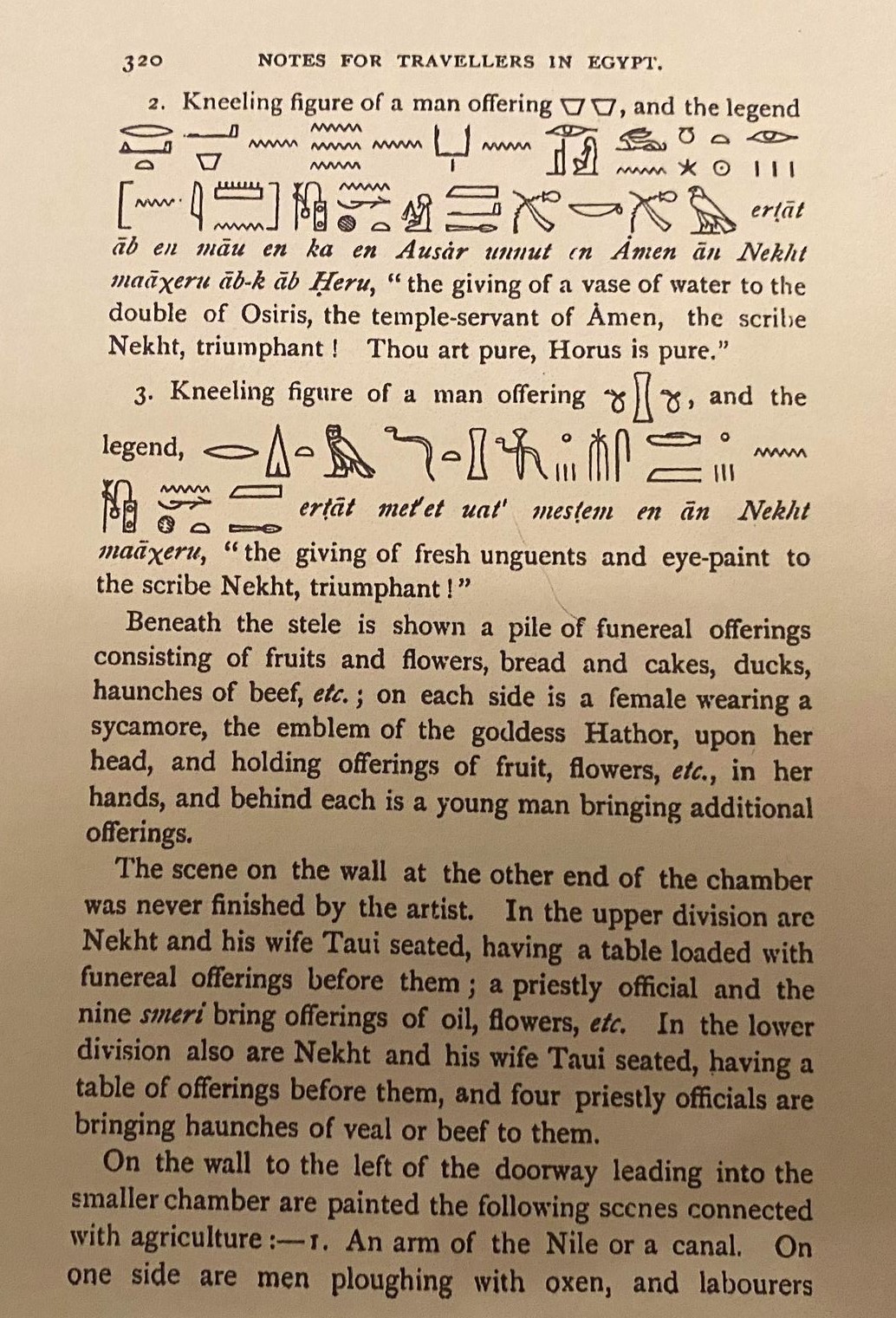
My daughter Kirsty used to work for Thomas Cook, and one Christmas as a surprise she bought me what turned out to be one of my favorite books 'The Nile - Notes for Travelers in Egypt, written by  E.A.Wallis Budge, who was an English Egyptologist, and Orientalist who worked for the British Museum and who wrote many books, including 'The Nile - Notes for Travelers, was written in 1895, and obviously there have been found many inaccuracies, but Wallis visited the tomb of Nakht, and deciphered a few of the registers, so I thought that you might like to read his interpretation of the hieroglyphics




Friday, 7 August 2020

A Tour Guide from Luxor who can actually read the Hieroglyphic Text

I do not live in Luxor anymore, but I would like
to introduce you
to an Excellent Tour Guide who has 24 Years of Experience and a High Diploma of Tour Guidance, and who lives in Luxor, but who is able to take guests to Visit Any Part of Egypt that they would wish to see. 

Have you ever wondered what the Hieroglyphics in the Temples say ? Then Look no further as Shahhat has the Answers for you. 

Unlike many Tour Guides he can actually read the Gods Word's written in the Tombs and Temples bringing thousands of years of silence to life again.

Shahhat Wannan  speaks perfect English and has an English Literature Degree, A High Diploma of Archaeology,  And a Master studying of Archaeology, he is a very educated well spoken and has a lovely sense of humor and a real passion for the history of Ancient Egypt.

This is Shahhat in KV 6 - the Tomb of Ramses 1X

I do Hope that you have a wonderful time Exploring all the Amazing Temples & Tombs in Luxor with Shahhat Wannan,  a very intellectual expressive Guide, with a Passion for Ancient Egypt, these are just a few of the Temples and tombs that he will guide you through in Luxor alone, If you have a place that you would like to see the most, you have only to ask,  and remember if you want to ask any questions about a text, he will translate the hieroglyphics for you. Enjoy your experiences in Egypt - Best Wishes from Lorraine Buczel

The EAST BANK  - Where the sun rises every morning it is the side of the Living and the Earthly Homes of the Gods : 

KARNACK TEMPLE & the OPEN AIR MUSEUM  - the Earthly Home of the Major God of Ancient Egypt, Amun Ra. 

Most tours just take you around Karnack Temple where you will experience the most amazing Hypostyle hall in the center of Karnack Temple, it is the reception area of the gods, its awesome lotus columns represent the plants that came into being on the mound of creation. The lotus columns are a symbolism of Horus who was born on the waters of creation, the lotus plant represents the first sunrise on the day of creation. Each evening the lotus submerges beneath the waters, and at dawn it rises symbolically to worship the sun again, it encompasses all the forces of nature and lives in all the four elements, its roots are bound to the earth and its stem rises through water, it flourishes in the air and blooms in the sunlight.

Karnack Temple is one of the largest Religious Complexes in the world, many Kings have helped to create it over a period of 2,000 years.

Normally tour companies do not include the Open Air Museum
in their tours, so we will probably have peace to enjoy this unexplored corner of Karnack Temple to ourselves.
In this little corner you will find Barque Chapels that have been rebuilt from pieces that were found inside the third pylon after an earthquake, I think the Gods wanted to share these amazing works of art with us. You will find the Exquisite White Chapel of Sensuret 1, It has twelve pillars, one for each month, an inscription on the north corner pillar reads : 'Come in peace, O sensuret, that thou mayest see thy farther Amun Ra who loves thee, and that he may give thee kingship of the two lands '

Hatshepsut created a very impressive unusual Red Barque Chapel for Amun Ra, and we will also find two beautiful Alabaster Barque chapels inside the Open Air Museum


Luxor Temple - Created to Celebrate the Opet Festival and is a 
unique Temple as it is not the Earthly home of a God, it was created to symbolically celebrate the Re-birth of the King and Egypt every year at the Opet festival
, where the God Amun Ra, his wife Mut, and their Son Khonsu would be carried from Karnack Temple escorted by the King, down the Avenue of Sphinx to Celebrate the Opet Festival in the Festival Hall created by Amenophis 111, where the King and Egypt would be Symbolically Reborn Every Year


THE WEST BANK - where the Sun Sets each evening, here the Kings created their Mortuary Temples and their Tombs. Here you can explore the famous Valley of the Kings, Howard Carter House and recreated tomb of Tutenkhamun in his garden. The Tombs of the Nobles are exquisite and have varied themes expressing the Nobles lives, some are Vibrant, some are sombre, and we can also experience the most famous piece of Armarna Art in the Tomb of Ramose

Just A few of the Temples that you might choose to Visit on the West Bank :

MEDINET HABU - The Mortuary Temple of Ramses 111, one of the last great Rulers of Ancient Egypt. 

A Kebnet (Court) was held here, where thirty members of the  Harem were put on trial in their attempt to kill the King. They were all found guilty and told to commit suicide in front of the court or their cells. After the hearing ten judges were found guilty of entertaining the accused during the trial and they had their ears and noses cut off. Medinet Habu also celebrates the Defeat of the Sea People by Ramses 111, the Sea people had invaded Egypt at the Delta following unrest in the Mediterranean

HATSHEPSUTS TEMPLE AT DIER EL BAHARI

let the experience of this really dramatic and impressive stage like temple with its gleaming white limestone colonnades seep into your bones. The Osiris statues of Hatshepsut smile down on the traveler in amused triumph holding the flail and whip, a symbol of power and fertility. It is incredible to stand and look at this hidden place of worship, admire it's breath taking simplicity of line and at the same time try and comprehend how such things could be accomplished thousands of years ago, a beautiful temple driven into and becoming part of the sheer pink and gold rock face that rises around it. This temple is the one thing above everything that testifies the strength and determination of a woman in a male dominated world.


The Valley of the Kings & Howard Carter House

We can start our journey having a look around Howard

Carters House, to get the feel of the man who discovered the Tomb of Tutankhamun in 1922.Inside the miniature museum are many personal belongings of Howard Carter, and it is interesting to experience this little house that the most famous archaeologist of all time lived in when he was working in the Valley of the Kings.


In the Garden of the Howard Carter house a replica of Tutenkhamun's tomb has been created, showing all the treasures exactly how they would have appeared to Howard Carter when he dug a small hole and by candle light peered through the hole, 'What can you see?' asked his patron Lord Carnarvon, 'Wonderful things!' exclaimed Howard Carter


The Valley of the Kings - Across the river Nile on the western shore of Thebes, there lays a desolate winding valley that hibernates within a barren and silent city for the dead, where no life can sustain on its parched desert rocks. In ancient days this was a secret place with only one way into the valley, its dusty road was only followed by the ritual funeral entourage of ancient times, and if you go into the valley you can only return by the road that you came. The sides of the valley twist and turn and contort into a mountain that forms a natural pyramid known as 'The Quorn', like the pyramids this is a ladder to the stars and eternal life. It encloses the subterranean tombs and final resting places of the once living Gods of Ancient Egypt,  the pharaohs of The New Kingdom. 

'I am yesterday Today and Tomorrow, and I have the power to be born a second time' - The Book of the Dead.


To Contact Shahhat Wannan :

Shahhat has a FACEBOOK Page - facebook.com/WannanTours

E-mail : sahhat_wannan@yahoo.com

Mobile : 00201001172180

Whatsapp - Calls are FREE if you have whatsapp from anywhere in the world - 00201223518174