Showing posts with label Tombs of the Nobles. Show all posts

Thursday, 4 March 2021

The Tomb of Nakht the Scribe and Astronomer of Amun - Hieroglyphics explained

In the burial chamber of Nakht the Scribe and Astronomer of Amun during the 18th Dynasty  a statue of Nakht holding a stela with the ‘Hymn to Re, was packaged for transportation to America, unfortunately the statue  was lost at sea in 1915 during the first world war when the ship was torpedoed by a U Boat,  so only copies of  the statue remain today.

The tombs of the Nobles are unique and a joy to visit as they each offer a glimpse into the lifestyle of the Official or Noblemen. TT52 is the tomb of Nakht who was a scribe, holding the title, 'Astronomer of Amun' at the Karnak temple during the 18th dynasty. His job was to study the location of stars, the sun and moon in order to schedule festivals and cult rituals for the temple. His wife, Tawy, was a musician of Amun, and in the reliefs she is referred to as 'His sister, his beloved, the Chantress of [Amon], Tawy. 'Mistress of the House', 'His sister, his beloved, with a place in his heart'


The tomb of Nakht is a very small tomb,  you can only comfortably get four people inside, This tomb is not large, and consists of a small corridor, a vestibule, another short corridor and the chapel, which includes a niche for a statue and a shaft, the tomb has some of the most beautiful and famous reliefs of all Ancient Egyptian tombs.  A naked maidservant is shown helping three ladies to prepare themselves for the banquet, the female figures, are young, sensual and sophisticated. Their rounded proportions are revealed through the plaits of their hair and translucent dresses, they have beautiful almond eyes. A blind harpist sits with his legs crossed before the festivities. One of the most famous pictures from any Egyptian tomb is in the centre of the banquet scene where a group of three female musicians entertain the guests with flute, lute and harp, it is a delightful scene 


The relief's show a farmer ploughing the fields with oxen, and many rural activities, including the cultivation of grain, digging of small canals for irrigation, harvesting, hunting, fishing and gathering grapes, while others press them to make wine,  flocks of birds rising and being dragged into a net, plucking and cleaning the birds. Nakht is portrayed with his wife and two small sons in a papyrus boat, grasping a hunting stick. 


There is a false door that is painted to look like pink granite, with four registers of offering bringers at the sides and a sub-scene of Nut as a tree-goddess gathering offerings. The ancient Egyptians believed that the dead could pass through the false door and inhabit statues in order to receive funerary offerings. This idea is reinforced on the door by six offering bearers who, while kneeling, offer water, beer, wine, clothing, unguent, fruit and vegetables. Turning the corner once again, we find bearers of the purification of offerings and priests before Nakht and his wife. 


Nakht's Tomb is located on the hillside of Abd el-Qurna, where the infamous tomb robber Ahmed Rassoul and his brothers lived who found a tomb with over fifty members of royalty that had been taken from their own tombs in the Valley of the Kings, this village was known as the village of the tomb robbers. The tomb was discovered by the villagers prior to being cleared by the Antiquities Service in 1889. In 1917, the English Artists, illustrators, and Egyptologists, Norman de Garis Davies and his wife Nina, published information on the tomb which received worldwide attention.


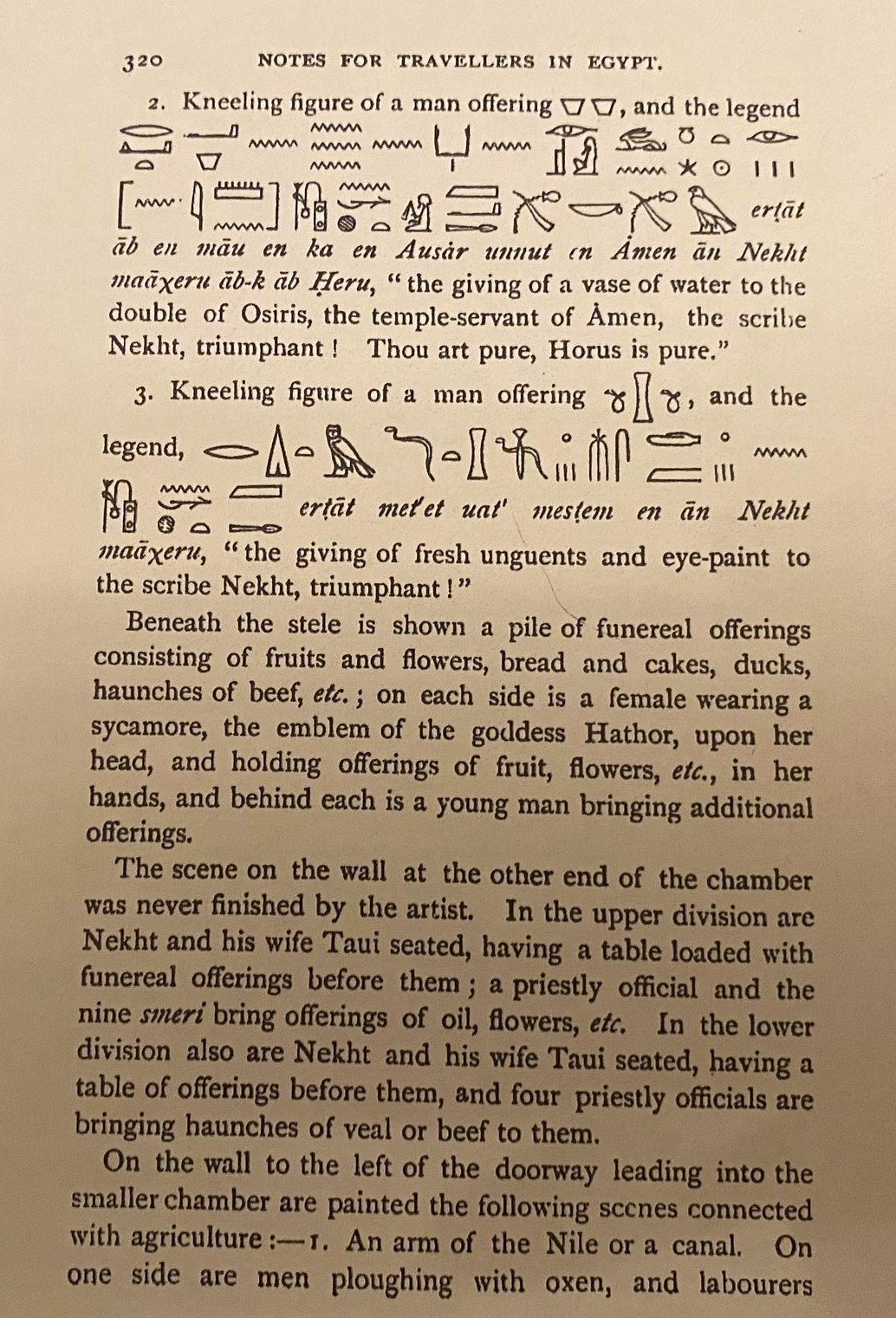
My daughter Kirsty used to work for Thomas Cook, and one Christmas as a surprise she bought me what turned out to be one of my favorite books 'The Nile - Notes for Travelers in Egypt, written by  E.A.Wallis Budge, who was an English Egyptologist, and Orientalist who worked for the British Museum and who wrote many books, including 'The Nile - Notes for Travelers, was written in 1895, and obviously there have been found many inaccuracies, but Wallis visited the tomb of Nakht, and deciphered a few of the registers, so I thought that you might like to read his interpretation of the hieroglyphics




Friday, 3 April 2020

The Tomb of Rekmire - An Ancient Egyptian Judge & Vizier of Tuthmosis 111


A judge is a straight thinking direct man, and Rekhmire’s Tomb symbolizes this with its sombre reversed T shaped design. The walls detail Rekhmire’s position and responsibilities as a judge, on entering the 66ft long and narrow vestibule I turned to the left to see a court in process with prisoners being brought before the court by the police.

Rekhmire offers advice on the walls of his tomb on the qualities necessary to hold the position of a Judge: ‘Know how to inspire fear and make yourself respected. He who is held in awe is a good judge, but the true function of a judge is to practice justice, if you fear him too much then there must be something wrong with him’ On the installation of a judge he advises; ‘see to those things that can be justly accomplished, do justice to everyman, a judge has a visible face, the water and the wind bear witness to his deeds which none can be aware of’.
On the wall opposite the court scene are five rows of interesting paintings of the conquered nations bringing their tributes to Egypt that Rekhmire must record and report to the king, At the top from the lands of punt  their people bring incense trees and baboons, the living animal representing the god of magical words Thoth, beneath them follow the Mediterranean peoples wearing kilts and carrying decorative vases and pots in the shape of animal heads, they bring silver and lapis lazuli,  a little monkey is shown cheekily climbing up the neck of a giraffe as the Kushittes of Africa escort cattle and leopards they carry the large eggs of the Ostrich and the feathers used for the royal fans
Tusks of Ivory are balanced over  their shoulders and in their hands they bring precious stones and
gold, the Syrians with their neat pointed black beards all dressed in long white gowns bring a young elephant and brown bear,  carts weapons and magnificent striding white horses. Finally slaves from all nations Following these scenes  across the wall I enter through the doorway directly facing the   door I find myself in a very long and narrow chapel like a hallway or  corridor, the right hand side represents the funeral aspect and events, with beautiful musicians playing their instruments at the funeral feast,  while the opposite wall details the depth of his power and position and the  work he was responsible for as he supervised all the work in the Temple of Amun and its workshops, the  craftsmen are busy making bricks, blowing glass, making gold, and under Rekhmire’s Instructions making a sphinx and cutting a seated colossal statue of  Tuthmosis. As I progress down the narrow chapel the gradient of the ceiling rises to a great height giving the impression of   mountain, Rekhmire had reached the top of the mountain when he became Vizier, he virtually controlled the land when Tuthmosis 111 was on Campaigns, which was for most of his reign as he was a Pharaoh determined to bring other nations under the submission of Egypt with his military force once again. At the end of the chamber looking up to the top of the wall a hole is cut that probably held the statue of Rekhmire where he would sit on his own throne looking down on his achievements in life.


The Tomb of Sennefer on the Westbank of Luxor

The Tomb of Sennefer who had held the position of Mayor of the Southern City under the reign of Amenhotep 11 during the 18th Dynasty can be found high on the hill directly facing the Rammessium Mortuary Temple.

Sennefer held many titles, he was not only the Mayor of the city and controller of Administration and taxes, but he also held the title of Overseer  of the Granaries of Amun, Superintendent of the gardens of Amun and High Priest of Amun, he was loyal to the king and efficient in his duties.

Deep cut steps lead me into the door well of the tomb and as I entered within, an arched tunnel enfolds  me, the walls are roughly cut, whilst shadows and the warm glow of lights guide me down 44 steep winding cavernous steps, at the bottom the tunnel bends sharply to the right, where I was completely unprepared for the total contrast and brightness of a small vestibule that I arrived in, it had a low undulating ceiling that seemed to hang low with the weight of the plump succulent grapes all waiting to be plucked painted on its surface. The artist has used the undulation of the ceiling to   create this glorious vineyard in a three dimensional effect, The Overseer of the Gardens of Amun was fortunate to have such a thriving succulent purple vineyard. The walls are bright white and bursting with beautiful small coloured images of Sennefer receiving offerings from the priests and his wife Meryt. Sennefer is also shown witnessing his funeral procession and the presentation of the funerary equipment to be placed inside his tomb.


Bending my body almost double to pass beneath a deep square entrance that leads into a larger square burial chamber, I was amazed by the vibrancy of bright yellow that bounces off the ceiling in geometric designs   and tapers off into more grapevines. This tomb is alive and blazing with colour that lifts your heart with gladness. Supporting the ceiling are four solid square cut pillars, I felt that these pillars are an expression of love between Sennefer and his wife Meryt The Lady of The House and Chantress of Amun, who is shown on each face of the pillars making offerings to Sennefer, she kneels beside him and stands along side him offering him gifts of Myrrh linen wine necklaces and a scarab to protect his heart in the Hall of Judgement. I feel that the pillars are a true expression of their commitment and love, showing Meryt in early stages of pregnancy on one pillar, in the very subtle way that the ancient Egyptians portrayed a woman’s ever increasing waist line.
The scenes on the walls detail the funeral procession, with Sennefer before Osiris and Hathor, again Meryt is present to support her husband whilst he worships Osiris and they are purified together by a priest in leopard skin, as a chantress of Amun Meryt plays her sistrum for her husband and carries a Menat necklace.


In a corner of the chamber painted in small detail Sennefer and Meryt sit beneath a belachin on board a small boat that is painted green, the colour is symbolic and like the papyrus it represents regeneration, their small boat is towed by a larger white one showing the captain, helmsman and rowers. The journey was to take Sennefer and Meryt on a pilgrimage to the Holy city of Abydos where the tomb of Osiris is said to be located.  Osiris had been killed by his wicked brother Seth, who then scattered the pieces of his body all over Egypt. Isis the wife of Osiris loved her husband so much that she desperately searched the land of Egypt until she found all the scattered parts, and then with her  magical powers she joined his body together again and resurrected him back to life, he was then made the Judge of the dead and Lord of the underworld by Amun. Many Egyptians made this pilgrimage to Abydos because at sunset   they believed it looked like a golden staircase leading to the afterlife


I feel that the tomb of Sennefer is a celebration in the most vibrant colours of a mortal life and the journey to the underworld embracing eternity of a successful nobleman who was supported by the deep love of his wife. As I climbed back up the staircase the vibrancy of this tomb had lifted my spirits more than the emergence through the door back into the blazing sun light beating down.