Thursday, 18 March 2021

A Special Celebration held for Ramses the Great at Luxor Temple

 On 18th April 2019 a very special celebration took place during the evening at Luxor Temple, an amazing Osirid statue of Ramses the Great standing 36ft high was unveiled and it stands beneath the left front pylon of the temple, the statue had been found broken and  in 57 pieces in 1958. 

The Horus, Mighty Bull, Exalter of Thebes, Favorite of the Two Goddess, establishing monuments for his father Amun who placed him on the Throne, Golden Horus seeking excellent things for him who fashioned him King of Upper and Lower Egypt, Usamatre, Chosen of Re, has been reborn.


In ancient Egypt, it was believed that if the name of the pharaoh was spoken again he would be reborn, so Ramses stands regally as the God Osiris, a primeval king of Egypt who became the Judge of the Underworld after he had been murdered by his jealous brother Set, and brought back to life again by his wife the Goddess Isis, who had travelled all over Egypt to find the parts of his body that Set had dismembered

Like the God Osiris, Ramses holds the crook and flail which signified the pharaonic authority. The shepherd's crook stood for kingship and symbolically expressed that the King was the Shepherd of his people, the flail was for the fertility of the land. Osiris had ruled Egypt, having inherited the kingship from his ancestors in a lineage stretching back to the creator of the world.  Ramses chose to be portrayed as Osiris who is connected with life-giving power, righteous kingship, and the rule of Maat, which represented ancient Egyptian concepts of truth, balance, order, harmony, law, morality, and justice


The main pylons of Luxor temple celebrate Ramses and his victory over the Hittites at the battle of Kaddesh which took place during the fifth year of the king’s reign. Ramses is shown in large relief whilst his enemies are represented in small scale to inspire his people of their Kings unquestionable supremacy and invincible strength against all the enemies of Egypt.  In faint relief on the right side of the pylon, is a depiction of the kings encampment before the battle is shown, his large tent stands in the center surrounded by the smaller tents of his troop, cavalry horses and chariots wait, whilst a lion trainer controls the beast that is anchored to a ring in the ground, a man is being beaten for information in the top corner of the encampment whilst soldiers continue with their normal chores and duties. On the highest level of the left pylon, Ramses charges fearlessly across the battleground, his bow is taught and the arrows ready to fly as his chariot recklessly hurtles in to the midst of his enemies, he is alone and completely surrounded cut off from his troops, he had compromised himself with his actions, and yet like the raging lion Sekhmet his strength is increased as he tears into the enemies scattering and maiming them beneath the wheels of his chariot.

Ramesses had 200 wives and concubines, 96 sons and 60 daughters, he ruled for over 67 years, his favorite wife was Nefertari who can be seen at the side of his leg as he is sat on the throne of two lands each side of the entrance into Luxor temple, to express his love for his Queen, Ramses had a beautiful tomb created for Nefertari in the Valley of the Queens, and among his many accomplishments, Ramses also created a temple at Abu Simbel for himself and a smaller one dedicated to Nefertari.. 

Ramses body had been removed from his tomb in the Valley of the Kings with about fifty other members of royalty, and he was hidden in a poor undecorated tomb DB320 by priests in the 23rd Dynasty who probably emptied the tombs in the Valley of the Kings for the wealth inside them, after the death of Ramses 111 during the 20th dynasty Egypt had gone into decline, and priests ruled the country not Kings. 

During the summer of 1871  Ramses mummy was found by a tomb robber named Ahmed Abd el Rassul,  Ahmed climbed down a thirty foot shaft, once inside the tomb he realized he had found a great collection of mummies, so he retrieved his goat that had fell down the shaft, and went in search of his brothers to tell them of his discovery, together the brothers decided that they needed a plan to  keep people away from the tomb and protect their discovery ensuring their wealth to come. They returned to the tomb and threw a dead donkey inside the shaft, the stench of the donkey as it decayed would erase any further curiosity from others, and possibly convincing any suspicious minds that a demon had woken in the tomb. Over the next ten years the tomb robbers prospered with their treasure trove that gradually made its way to the hands of collectors and auction houses. Eventually The Antiquities service realized that a tomb must have been found, and so Sir Gaston Maspero sent one of the museum staff Emile Brugsch to discover where the artifacts were coming from. Emile presented himself as a wealthy buyer which gained the trust of the traders, and finally led him to the Abd Rassul Brothers. The brothers were arrested and tortured and despite a severe beating on the soles of the feet they would not give their discovery away, eventually after a month they were released, but then the police harassed their family and the villagers at Quarna continuously until eventually one of the brothers confessed to the police where the tomb was to avoid any further harassment of themselves or the rest of the villagers.

After 3,000 years of seclusion the Royal mummies left the tomb DB320 near the Mortuary Temple of Hatshepsut at Dier El Bahari  and were carried by donkeys and mules to the banks of the Nile where they were transported to Cairo. Women came to the riverbank and wailed in mourning for the deceased kings and their kin. Never in the history of any nation has there been such an awesome entourage of deceased royalty, the glory of Ancient Egypt rose again as their pharaohs traveled to safety in Cairo, their final resting place, where modern scientists now continue the work of some of the ancient priests to protect and preserve the mummies of their kings.


Thursday, 4 March 2021

The Tomb of Nakht the Scribe and Astronomer of Amun - Hieroglyphics explained

In the burial chamber of Nakht the Scribe and Astronomer of Amun during the 18th Dynasty  a statue of Nakht holding a stela with the ‘Hymn to Re, was packaged for transportation to America, unfortunately the statue  was lost at sea in 1915 during the first world war when the ship was torpedoed by a U Boat,  so only copies of  the statue remain today.

The tombs of the Nobles are unique and a joy to visit as they each offer a glimpse into the lifestyle of the Official or Noblemen. TT52 is the tomb of Nakht who was a scribe, holding the title, 'Astronomer of Amun' at the Karnak temple during the 18th dynasty. His job was to study the location of stars, the sun and moon in order to schedule festivals and cult rituals for the temple. His wife, Tawy, was a musician of Amun, and in the reliefs she is referred to as 'His sister, his beloved, the Chantress of [Amon], Tawy. 'Mistress of the House', 'His sister, his beloved, with a place in his heart'


The tomb of Nakht is a very small tomb,  you can only comfortably get four people inside, This tomb is not large, and consists of a small corridor, a vestibule, another short corridor and the chapel, which includes a niche for a statue and a shaft, the tomb has some of the most beautiful and famous reliefs of all Ancient Egyptian tombs.  A naked maidservant is shown helping three ladies to prepare themselves for the banquet, the female figures, are young, sensual and sophisticated. Their rounded proportions are revealed through the plaits of their hair and translucent dresses, they have beautiful almond eyes. A blind harpist sits with his legs crossed before the festivities. One of the most famous pictures from any Egyptian tomb is in the centre of the banquet scene where a group of three female musicians entertain the guests with flute, lute and harp, it is a delightful scene 


The relief's show a farmer ploughing the fields with oxen, and many rural activities, including the cultivation of grain, digging of small canals for irrigation, harvesting, hunting, fishing and gathering grapes, while others press them to make wine,  flocks of birds rising and being dragged into a net, plucking and cleaning the birds. Nakht is portrayed with his wife and two small sons in a papyrus boat, grasping a hunting stick. 


There is a false door that is painted to look like pink granite, with four registers of offering bringers at the sides and a sub-scene of Nut as a tree-goddess gathering offerings. The ancient Egyptians believed that the dead could pass through the false door and inhabit statues in order to receive funerary offerings. This idea is reinforced on the door by six offering bearers who, while kneeling, offer water, beer, wine, clothing, unguent, fruit and vegetables. Turning the corner once again, we find bearers of the purification of offerings and priests before Nakht and his wife. 


Nakht's Tomb is located on the hillside of Abd el-Qurna, where the infamous tomb robber Ahmed Rassoul and his brothers lived who found a tomb with over fifty members of royalty that had been taken from their own tombs in the Valley of the Kings, this village was known as the village of the tomb robbers. The tomb was discovered by the villagers prior to being cleared by the Antiquities Service in 1889. In 1917, the English Artists, illustrators, and Egyptologists, Norman de Garis Davies and his wife Nina, published information on the tomb which received worldwide attention.


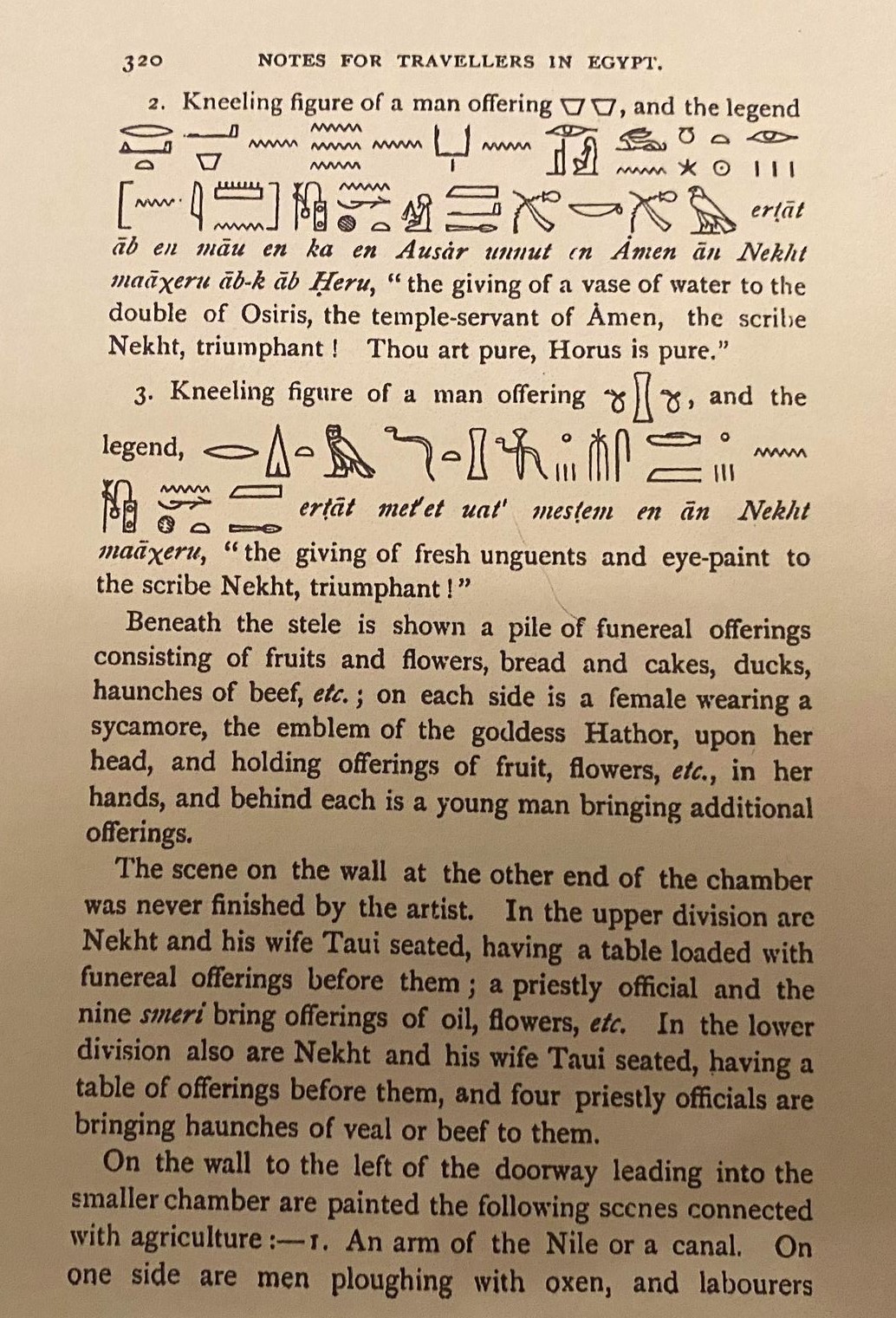
My daughter Kirsty used to work for Thomas Cook, and one Christmas as a surprise she bought me what turned out to be one of my favorite books 'The Nile - Notes for Travelers in Egypt, written by  E.A.Wallis Budge, who was an English Egyptologist, and Orientalist who worked for the British Museum and who wrote many books, including 'The Nile - Notes for Travelers, was written in 1895, and obviously there have been found many inaccuracies, but Wallis visited the tomb of Nakht, and deciphered a few of the registers, so I thought that you might like to read his interpretation of the hieroglyphics


Tuesday, 2 March 2021

Nina De Garis Davis - A wonderful Egyptologist Artist who brought the tomb paintings to life once more

In 1906 the Artist and illustrator Nina Macpherson Cummings decided to visit some friends in Alexandria in Egypt, which sparked in her an interest in Ancient Egypt and its monuments.  Whilst in Egypt she met Norman de Garis Davies. They became engaged, and were married in England in 1907 and then they immediately departed for Egypt where Norman had been  offered employment as the head of the graphic section of the Metropolitan Museum of Art’s new expedition to Egypt.


Although Nina was unemployed when they arrived in Egypt she began painting to assist her husband Norman in his work, whilst living in Luxor they met Alan Gardiner, a really interesting Character who is known as 'the Father of British Egyptology' who lived in a tomb on the West Bank of Luxor. Sir Alan had taken a walk over to the Valley of the Kings one day,  and started the numerical record giving each of the known tombs at that time their own number, this is still in use today. Alan Gardiner wrote 'The Manners and Customs of the Ancient Egyptians'. 

Working from  Luxor Nina and her husband Norman used their amazing artistic skills and polychromy (the art of painting in several colours, especially as applied to ancient pottery, sculpture, and architecture) to recreate tomb reliefs, using a technique that nearly replicated the exact brushstroke and colors of the tombs in the Valley of Kings and Queens, Dier El Medina, the Actual Artists tombs, and the tombs of the Nobles. Their copies reflected the actual scene, including any damage that may have been sustained over time or as the result of vandalism. In a some cases, the drawings were rendered to look like they would have when created several thousand years ago.

 All the tombs in the Valley of the Kings  show the kings in the companionship of the Gods, unlike the tombs of the Nobles that actually showed the nobles enjoying their life in paradise, or their earthly work, many of the nobles were Viziers, which held the responsibility of ruling the country if the king was away on campaign. The Nobles tombs are vibrant, and each tomb tells a different story which is interesting

Nina was offered work for the Metropolitan Museum, and after seeing her art work Sir Alan Gardiner Wilkinson also employed her, so she spent half of her time making drawings for the Metropolitan Museum and spent an equal amount of time replicating the tomb paintings for Alan Gardiner who came to an arrangement with Nina that he would acquire as much of her painting as he could afford. He collected her work until 1929


Nina painted this relief in the lovely little Tomb of Nakht TT52 on the hillside of Shiek Abd Qurna on the West bank. Nakht was an Astronomer of Amun during the reign of Tuthmose 1V in the 18th Dynasty

At the beginning of the twentieth century, it was normal for paintings in Egypt to be made using water colours, which produce a rather flat finish, Norman and Nina chose Theban Tomb 45 as a testing ground for experiments in colour copying. One of their first assistants, Francis Unwin,  suggested the use of tempera, specifically egg tempera. The opaque result of this was much more satisfactory, and this technique became the basic method.

The tomb that they chose for their trial work was TT45, one of the Nobles tombs located in Sheikh Abd el-Qurna,  on the west bank of the Nile, opposite modern Luxor. It is a very unusual tomb as It was originally the burial place of the ancient Egyptian named Djehuty (Thoth), who was a scribe of the offering-table of Mery, high-priest of Amun, head of all the weavers of Amun, and steward of Mery, high priest of Amun, during the reign of Amenhotep 11 of the 18th Dynasty, The tomb was reused several hundred years later, in the Ramesside Period, by a man named Djehutyemheb (Thothemheb). He was head of the makers of fine linen of the temple of Amun. Djehutyemheb was the son of the head of the weavers named Wennefer and his wife Isis. Djehutyemheb's wife was named Bak-Khonsu. She was a songstress of Amun.


Norman died in his sleep of heart failure on 5 November 1941, at the age of 76. This event, and the Second World War, drew the work of the Davis's to closure in Luxor. On her return to England to take her mind off her bereavement, she immediately set herself to sorting out the mass of material left over from their years of working in Egypt. Meeting and marrying Norman offered Nina a rewarding life that was enhanced with her creative talents, she was a quiet shy lady who was happy to paint and support her husband, and together they embraced and enhanced the art of Ancient Egypt. Nina died in 1965.


Tuesday, 23 February 2021

Sir John Gardiner Wilkinson with excellent characters who brought ancient Egypt to life again

 Sir John Gardiner Wilkinson had a very interesting life in Egypt, Wilkinson lived during the ‘golden age of scholarship and adventure’ — between Champollion’s decipherment of hieroglyphics and the discovery of King Tutankhamun's tomb in 1922. Whilst living in Egypt he dressed in the style of a Turk, his friend Robert Hay joined him bringing with him a Greek woman, that he had bought in the market of slaves in Cairo, even though Slavery was not pursued in England, it was actively accepted in Egypt during the period of time. Wilkinson married his slave, as initially she would not have anything to do with the 'infidel'. Many interesting characters came into his tomb home, which became an inescapable passage known to all, and famous for its comfort, parties and receptions were given regularly.


Wilkinson actually lived inside a tomb halfway up the hill of Sheikh Abd el-Qurna, on the West Bank of Thebes (luxor) this area was known as the Village of the Tomb Robbers, he built his garden around the entrance to the tomb of Ahmose, he had a Pidgeon house, a grand mudbrick tower and surrounding wall to enclose a garden and courtyard to obscure the monumental portico of the original tomb. His guests arrived on thursday nights and enjoyed a relaxing evening surrounded by the beauty of the tomb reliefs in his home.

His local neighbors were the Rassoul family, tomb robbers who had found a tomb (DB320) with the mummies of over fifty Kings and royalty in a tomb near to the Temple of Hatshepsut, they had kept the tomb a secret for over ten years, and sold artifacts to tourists during the winters, the kings had been taken from their own tombs in the Valley of the Kings to supposedly protect them from Tomb Robbers. 


Ahmed Rassoul also lived in a tomb on the hillside with his mother fendia, his daughter and granddaughter, his mother can be seen wearing a pharaonic collar

Wilkinson's own tomb home could be seen from most of the valley below because of the portico and pillars which form its monumental entry, the tomb belongs to Amethu called Ahmose, who carried the titles of Mayor of the City (Thebes) who was the  Vizier of Tuthmosis 111, which is the highest position in the land, and when the King was absent from the country on campaigns Ahmose was responsible of all duties of Egypt  on behalf of Tuthmosis 111 

Wilkinson began his Egyptian studies during a very important time in the development of Egyptology, he became friends with Champollion who had actually deciphered the hieroglyphics, Although he had the utmost respect for his friend Champollion he was able to correct through research some of Champollion's mistakes

During his stay in Egypt , Wilkinson visited virtually every known ancient Egyptian site, and skillfully recorded inscriptions and paintings as a talented copyist and compiling copious notes, he published his most significant work ' Manners and Customs of the Ancient Egyptians'  Acclaim for this publication brought Wilkinson a knighthood in 1839 and ensured him the title of the first distinguished British Egyptologist.

He remained in Egypt until 1833, traveling extensively through the country. He learned Coptic and Arabic, and continued his study of Hieroglyphics, there was hardly an ancient Egyptian site known at that time that Wilkinson did not visit and record in his notebooks. His interest was almost an obsession. There was no inscription, regardless of how small or incomplete that was too insignificant for his attention.

Whilst living on the West Bank Wilkinson copied scenes and inscriptions in the tombs of the Nobles, One morning he walked over to the Valley of the Kings and he assigned numbers to the twenty tombs that were known during that period in time, establishing the numbering system still used today. In fact, modern Egyptologists frequently consult his notes on Thebes particularly for private tomb scenes which were copied by him but since have been damaged or even completely destroyed. Through this work, he was able to identify the names of many of the ancient Egyptian kings for the first time. His copies of texts and other drawings are extremely precise,

Wilkinson was a pioneer of Egyptology and he is often rereferred to as 'the Father of British Egyptology'. He copied scenes and inscriptions in the private tombs of the Nobles, and also surveyed the known tombs in the Valley of the Kings, and produced the first comprehensive plan of ancient Thebes, as well as a chronology of the New Kingdom dynasties, modern Egyptologists frequently consult his notes on Thebes particularly for private tomb scenes which were copied by him but since have been damaged or even completely destroyed. Through this work, he was able to identify the names of many of the ancient Egyptian kings for the first time. His copies of texts and other drawings are extremely precise.

Wilkinson returned to England for his health's sake in 1833, he went on to publish his researches in a large number of publications. His most significant publication was Manners and Customs of the Ancient Egyptians, it was first published in three volumes in 1837 and was illustrated by Joseph Bonomi. Acclaim for this publication brought Wilkinson a knighthood in 1839 and ensured him the title of the first distinguished British Egyptologist.

My BLOG was inspired by the writing of Chris Naunton and his new publication Egyptologists Notebook, that brings this period of time, its excellent characters and how they brought ancient Egypt to the attention of the world. It is a really good read.


Tuesday, 9 February 2021

Alexander the Great Conquers Egypt & by carving his presence into the walls of the barque shrine at Luxor Temple, Alexander was now ordained into the everlasting cycle of kingship

Alexander the Great was the son of Philip II of Macedonia with one of his wives, Olympias, who From being a young child his mother encouraged him to believe that he was a descendent of heroes and gods, and his birth right was divine. Alexanders father arranged for him to be tutored by Aristotle himself, whose  education infused him with a love of knowledge, logic, philosophy, music and culture. The teachings of Aristotle gave him the understanding of how to treat his new subjects in the empires he invaded and conquered, allowing him to admire and maintain the countries religions and cultures.

With the belief in himself that his mother had impressed on him, Alexander was said to have a great charisma and forceful personality which gave him the ability to motivate his army to do what seemed to many to be impossible. He was a visionary who could plan and strategize his way to success, he motivated his men who knew they were part of one of the greatest conquests in history. 

Alexanders father Philip II was assassinated in 336BC by the captain of his bodyguard, Pausanias, who was also his son and had previously been designated as his heir,

The Oracle of Amon at Siwa Oasis & the founding of Alexandria

The Macedonian noblemen and army proclaimed Alexander as King of Macedonia, and he continued with his fathers conquests and arrived in Egypt in October 332 B.C. where the Egyptians surrendered without a fight. Travelling to Siwa Oasis  to the village of Aghurmi  Alexander consulted the oracle of Amun, who confirmed him as both a divine personage and the legitimate Pharaoh of Egypt, and he was pronounced the son of the deities Zeus and Amon by the Oracle, and was then often referred to as Zeus-Ammon. 


The floor plan of the temple reveals a hidden passage and chamber from which it would have been possible for a concealed priest to simulate the voice of the oracle. but with the oracles words of Alexanders destiny he then travelled to  the northern Coast of Egypt where he founded the famous city of Alexandria and he himself marked out where the agora was to be built and decided how many temples were to be erected and to which Ancient Egyptian Gods they were to be dedicated.  He had the city built  to face the rising sun on the day that he was born. 

Alexander and The Festival of the Opet with the god Amun Min in Thebes (luxor)

Alexander understood the symbolism of Ancient Egyptian festivals and ceremonies. Every year the ancient Egyptians eagerly anticipated the coming of Akhet, the flooding season. Akhet was the most important event in the Egyptian year that celebrated the Nile’s floodwaters replenishing the land and restoring Egypt’s fertility. This time of joyous renewal was also when ancient Egypt held one of its most spectacular and most mysterious festivals: the Feast of Opet, a very important festival, for which luxor temple had been especially created, and was held each year to both symbolically to renew the Life of both Egypt and the pharaoh, the celebrations perpetuated the divine royal ka. Each year the spirit of kingship that linked the living king with the gods and all his royal predecessors was renewed with great ceremony


The festival began with a grand procession from Karnak Temple to  Luxor Temple. In this procession, statues of the city’s most sacred gods Amun-Re, his wife, Mut, and his son, Khonsu were escorted by the ruling pharaoh and placed in special vessels called barques and were carried by priests down the avenue of sphinx that connected the two temples for two miles from the earthly home of Amun at Karnack Temple to Luxor Temple, a unique temple in all of Egypt that had been created to celebrate this festival which lasted for 11 days. Even today Modern Egyptians hold a celebration where boats are carried around the town

Alexander had the original Barque Shrine of Amun-Re reconstructed  inside what is often referred to as the Third Antechamber where the reliefs presented On the exterior walls now show Alexander  as Pharoahhim, the legitimate heir of the pharaohs. During the feast of the Opet, the rites show him in the presence of Amun Min the god of Fertility. By carving his presence into the walls of the barque shrine, Alexander was now ordained into the everlasting cycle of kingship. In the reliefs Alexander receives the two crowns of both Upper and Lower Egypt, declaring him to be King of all Egypt


Inside the shrine, reliefs show Alexander portrayed as the rightful Egyptian king, accompanied by various gods. Above these scenes is a dedication formula that acknowledges Alexander's esteemed ancestor: "He [Alexander] has created the great chamber anew in white and beautiful sandstone after it existed since the time of the majesty of the king of Upper and Lower Egypt, Nebmaatre, Son of Re Amenhotep, Ruler of Thebes."

Above the lintel of the doorway into this antechamber, a small chamber was built into the wall that was just large enough to accommodate a man. It was concealed by removable slabs, and accessed by holds cut in the wall. Some scholars believed this to be a priest-hole, where a priest would conceal himself during religious ceremonies. He would then be the voice of Amun, when priests asked questions of the god. Alexander did not stay in Egypt long. By 331 BC he was on his way west to complete his conquest of the Persian Empire, but the impact of his conquest in Egypt was significant. Alexander had  respected Egyptian culture and religion, but he installed a Greek government to control his administration of Egypt. Greek influence in Egypt was reinforced by the settlement of Greek veterans throughout Egypt, where they became a privileged aristocracy that gradually assimilated with the Egyptians. Alexander had also founded a new Greek capital, Alexandria, located on the Mediterranean at the mouth of the Nile.

Although Alexander would never return to Egypt, he died in Babylon in 323 BC, the Greek rule that he established proved more enduring. In the crisis after Alexander's death, Ptolemy, one of his generals, claimed Egypt as his kingdom and established hereditary rule. The Ptolemaic Dynasty would last until the Romans conquered Egypt in 32 BC, and incurred the death of the Famous Ptolemaic Queen Cleopatra,  who had children with both Julias Ceasar and Mark Antony

Friday, 5 February 2021

Tutankhamun was buried with 130 Walking sticks & Staffs & his two Stillborn Daughters

Tutankhaten “the living image of Aten.” Came to the throne at the age of nine and ruled for ten years, Egypt had almost been brought to the brink of Disaster by his father Akhenaten, who had  closed all the Temples down, and declared that the Egyptians must only worship one God, the Aten, he had taken the capital from Waset (luxor) and moved to the desert to create a new capital Akhetaten.  After Akhenatens death Tutankhaten changed his name to Tutankhamun and returned to Waset, reinstating the Ancient Egyptian God Amun and the temples

Genetic testing in 2010 on Tutankhamun's mummy, showed that he was a frail young man when he died at the age of 19, the tests also  verified that Tutankhamun was the grandson of the great pharaoh Amenhotep III, who created amongst other things the great festival hall in Luxor Temple. 


Discovered in the tomb of Tutankhamun there were 130 staffs and walking sticks, some of the sticks show clear signs of use. Some of Tutankhamun's walking sticks were symbolically carved with prisoners of Egypt's traditional African and Asiatic enemies. When the king grasped this cane, the captives were turned upside down and therefore became magically rendered harmless, and under the full subjugation of Tutankhamun. This beautiful walking stick is carved with a Nubian man, his face, hands and feet are made out of ebony and he is represented wearing a short curly hair wig and a pleated garment

CT scans have revealed that Tutankhamun's left foot was crippled with a bone necrosis which would have made walking painful and difficult. In Ancient Egypt Pharaohs married their sisters and daughters to keep the blood lines pure, but this in- breeding possibly contributed to Tutankhamun's poor health and early death. DNA tests published in 2010 revealed that Tutankhamun’s parents were brother and sister and that his wife, Ankhesenamun, the daughter of Akhenaten and Nefertiti, was also his half sister.  When Tutankhamun's tomb was cleared of it's treasures two tiny mummies, his daughters were found to have been stillborn. In 1932 an autopsy was carried out on the mummies, the first child still had a part of the umbilical cord attached, and was probably born four months premature, the second child also a daughter had been born two months premature.


Tutankhamun is the only King still inside his tomb in the Valley of the Kings, he is on display with a glass coffin lid. His Golden Mask and all his treasures are at the Egyptian Museum in Cairo, his collection will eventually move to the new Grand Egyptian Museum in 2021.

Thursday, 4 February 2021

The Tomb of Ramses 111 (KV11) - The treacherous journey through the hours of the Night in the Underworld

 KV 11 is the tomb of Ramses 111  Usermaatre-Meryamun, who was considered to be Egypt's last great Pharaoh, Ramses brought stability back to Egypt when the country was plunged into chaos when the Sea People tried to invade his country.  before Egypt was plunged into chaos, the battles are carved onto his mortuary temple at Medinet Habu he led his troops to the delta and repelled the foreign invaders 

His tomb has been open since antiquity, and among various other names, has been referred to as Bruce’s Tomb (after Scottish traveler and travel writer James Bruce whom entered the tomb in 1768) and Harper’s Tomb, due to a wall mural featuring two blind harpers in one of the small annexes off the first corridor symbolizing the musicians the pharaoh would be bringing with him into the afterlife. Rameses III’s mummy  was discovered among a cache of other royal mummies in 1881 by a tomb-robber named Abd el-Rassul near the site of Deir el-Bahri. Along with over forty other royal members Ramses was taken to the museum at Cairo

This long tomb is beautifully decorated, The second corridor is decorated with the Litany of Re, which praises the God Amun in all his known names, it invokes the sun, Ra, in 75 different forms. The Litany of Re is also known as  'Book of Praying to Re in the West, Praying to the United One in the West' and was an important ancient Egyptian funerary text of the New Kingdom period, and could only be used by Pharaohs or very high ranking nobles

 At the end of this corridor the axis of the tomb shifts. This third corridor is decorated with the Book of Gates which explains the passage of a newly deceased soul into the next world,  each hour of the night he must pass through a new gate, to which he must no the necessary greeting for the guardian at the gate to be able to pass through,  The text implies that some people will pass through unharmed, but that others will suffer torment in a lake of fire.


The Amduat has a depiction of  a goddess with the Red Crown of Lower Egypt, standing in front of a guardian serpent with four legs and a human head, The Amuduat was reserved only for pharaohs, its meaning is 'That Which Is In the Afterworld', also translated as 'Text of the Hidden Chamber Which is in the Underworld, It tells the story of Ra, the Egyptian sun god who travels through the underworld, from the time when the sun sets in the west and rises again in the east. It is said that the dead Pharaoh is taking this same journey, ultimately to become one with Ra and live forever.


The underworld is divided into twelve hours of the night, each representing different allies and enemies for the Pharaoh and the sun god to encounter. The Amduat names all of these gods and monsters. The main purpose of the Amduat is to give the names of these gods and monsters to the spirit of the dead Pharaoh, so he can call upon them for help or use their name to defeat them.

The journey hour by hour through the subterranean tomb :

In hour 1 the sun god enters the western horizon (akhet) which is a transition between day and night.

In hours 2 and 3 he passes through an abundant watery world called 'Wernes' and the 'Waters of Osiris'.

In hour 4 he reaches Imhet the difficult sandy realm of Seker, the underworld hawk deity, where he encounters dark zig zag pathways which he has to negotiate, being dragged on a snake-boat.

In hour 5 he discovers the tomb of Osiris which is an enclosure beneath which is hidden a lake of fire, the tomb is covered by a pyramid like mound (identified with the goddess Isis) and on top of which Isis and Nephthys have alighted in the form of two kites (birds of prey).

In the sixth hour the most significant event in the underworld occurs. The ba (or soul) of Ra unites with his own body, or alternatively with the ba of Osiris within the circle formed by the mehen serpent. This event is the point at which the sun begins its regeneration; it is a moment of great significance, but also danger.

In hour 7 the adversary Apep (Apophis) lies in wait and has to be subdued in chains by the magic of Isis 

In hour 8 the sun god opens the doors of the tomb and Horus calls upon a monstrous serpent with the unquenchable fire to destroy the enemies of his father, Osiris, by burning their corpses and cooking their souls.

In hour 9 they leave the sandy island of Seker by rowing vigorously back into the waters.

In hour 10 the regeneration process continues through immersion in the waters.

In hour 11 the god's eyes (a symbol for his health and well-being) are fully regenerated.

In hour 12 he enters the eastern horizon ready to rise again as the new day's sun.

Once the deceased finished their journey through the underworld, they arrived at the Hall of Maat. Here they would undergo the Weighting of the Heart ceremony where their purity would be the determining factor in whether they would be allowed to enter the Kingdom of Osiris.

Ramses quartz sarcophagus was removed by the Italian explorer and former circus performer Giovanni Belzoni, who also found the tomb of Seti 1, he had been sent to Luxor by a man named Salt, to collect a head of Ramses 11 from his mortuary temple, the Rammessium, and once it was on it's way to Cairo, he then went into the Valley of the Kings, the sarcophagus of Ramses 111 is now at the Louvre Museum in Paris, whilst its lid is in the Fitzwilliam Museum in Cambridgeshire

Tiy a lower wife of Ramses was found to be the main culprit instigating a death plot to murder Ramses 111, as she wanted her son Pertwere to succeed to the throne.

A  priest who practiced the arts of  magic, created wax figurines potions and wrote magical spells to kill Ramses, In ancient Egypt words were magical, and had the power to evoke the power of life and death. The spells cast against Ramses and the black magic did not kill him and unfortunately for the conspirators of this devious plot, their intentions were considered as deadly and as serious as an actual physical assault on Ramses, the magic invoked was as terrible a threat as trying to cut him down with a sword.

Thirty conspirators of the harem were put on trial, they were sentenced to death and told to commit suicide in front of the court or in their cells, after their trial, ten judges also faced trial for having taken meals with the accused during the trials, they were condemned to have their ears and nose cut off.

Recently Ramses body has been put through a scanner and it was discovered that his throat had been cut.